I. Off-Grid Is a Design Architecture
The starting point of off-grid is to place the energy control point where your own intent can reach it.
Once there is a range within which you can decide for yourself, energy changes from something you merely consume into something you can design.
From a stand-alone mountain hut to factories, communications sites, medical facilities, and regional infrastructure, the scale and purpose may differ.
What they share is an architecture in which the functions required at that location can be judged locally and kept operating over the long term.
What we seek is a state in which every energy user has a range within which decisions can be made.
When, how much, where, and in what way should electricity flow?
The ability to make those decisions autonomously according to the site’s constraints is where the freedom of off-grid lies.
Constraints are what turn an ideal into a real system.
By defining available power, equipment, cost, time, and maintenance capability correctly, the shape of an implementable future becomes concrete.
This requires the perspective of knowing what is sufficient.
When the required power is estimated correctly, the functions that must be protected and the capacity needed to protect them become visible.
Knowing what is sufficient means creating a state in which you can choose what to prioritize and how long it must continue.
Off-grid is a design architecture that decides, from real constraints, how much to entrust to external systems and from what point to bring control back within your own reach.
II. What Is “JIZAI”? — Internalizing the Control Point
What we call JIZAI is a design state in which the control point remains at hand and the system can autonomously choose among permitted operating states.
Observe the situation, use energy, store it, switch, stop, and restart. Keeping those choices within your own reach is what we mean by JIZAI.
For long-term operation, what matters is being able to design how far essential functions should continue, how the system should change state as conditions change, and how it should restart.
When continuity and recovery can both be designed locally, operational freedom expands substantially.
Once protected functions are prioritized and required continuity time and recovery procedures are defined, the necessary capacity, redundancy, and control methods become concrete.
As a result, cost and risk converge naturally within the constraints, producing an architecture that can actually be implemented.
This makes essential functions less likely to be interrupted.
“Not stopping” is the outcome of an architecture that can choose, switch, and recover under local control.
Off-grid is the architecture that implements this state of JIZAI as a power system.
III. Autonomous and Distributed Design Is One of the Oldest and Most Robust Forms
Looking back through history, daily life was originally autonomous and distributed.
People drew water from wells, split firewood, and secured their own light.
The energy they needed was obtained and controlled within a reachable range.
The emergence of electric infrastructure brought enormous benefits.
At the same time, control became increasingly centralized, and users moved toward the role of simply consuming what was supplied.
Centralized systems created tremendous efficiency and convenience.
By combining that strength with local autonomous control, it becomes possible to design for both efficiency and recoverability.
The strength of autonomous and distributed design lies in its ability to localize failures, simplify control, and make the requirements for human intervention explicit.
The more each small unit can decide for itself, the more recovery options the whole system retains.
Off-grid is a design architecture that adds autonomy where it is needed while retaining the efficiency of centralized infrastructure.
Combining large infrastructure with smaller autonomous sites expands the options available to society as a whole.
IV. Distributed Measurement and Control Open the Next Energy Architecture
By 2026, the environment for distributing observation and decision-making had matured, greatly expanding the freedom available in energy-system design. Centralized management, distributed control, synchronization, and asynchronous operation can now be combined according to purpose and constraints.
The idea of distributed energy itself is not new.
In earlier periods, however, implementation constraints were larger, and it was difficult to build architectures that could withstand long-term operation.
A major turning point has been the evolution of power semiconductors.
High-speed, high-efficiency power conversion and millisecond-scale measurement and control have become practical, creating a foundation for precise operation of distributed power sources.
Bringing distributed measurement and control closer to the field creates new design options:
- Place control points closer to the field and respond quickly to changes in state.
- Maintain units that can operate asynchronously and preserve more choices during transitions.
- Combine forecasts with actual measurements and correct operation through local judgment.
- Contain failures within a small area and recover in stages.
Architectures that sustain long-term operation tend to converge toward placing control points nearby, maintaining a locally decidable range, and localizing failures.
The tighter the constraints, the more clearly the strength of this architecture appears.
Microgrids and smart grids contain valuable elements, but final stability is determined by the control architecture.
The next article in this series compares these structures from that perspective.
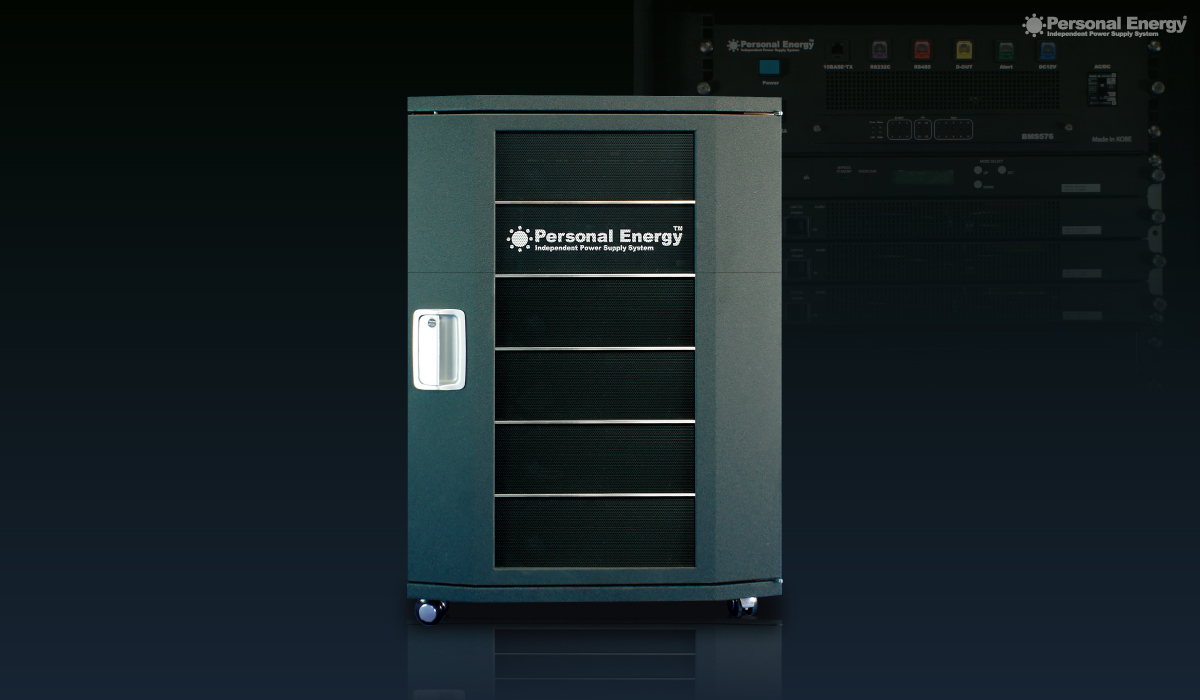
V. Personal Energy — A Dedicated Off-Grid System That Implemented JIZAI in 2011
On January 17, 2011, Kei Communication Technology Inc. began developing and selling Personal Energy, a dedicated system designed to realize off-grid operation in Japan.
It was the result of turning the design principle of placing electric power under local control into an implementable architecture through roughly ten years of development and the technologies available at the time.
This design concept was later protected through Japanese trademark application No. 2014-097591.
What we provide is an architecture that protects essential functions, changes state as conditions require, restarts, and continues operating.
Preserving room for the operator to make decisions is what gives long-term operation its strength.
Before the term off-grid became widely used, we had already been treating JIZAI as a design state and developing autonomous, distributed power architectures.
VI. Off-Grid Becomes Infrastructure for a Future with Choices
Off-grid is a design for the future that can begin at today’s site.
Design the energy required at your own location, for your own needs.
Decide how much to leave to the grid and from what point to operate locally. The more accurately constraints are defined, the more clearly implementable choices emerge.
Use the strength of the grid while retaining a range that can be decided locally.
A two-layer architecture that combines large infrastructure with autonomous sites expands the choices available for the future.
Connect.
Disconnect.
Choose.
Control.
Retain choices that can be decided locally. This is the state of JIZAI, and it is the destination that off-grid seeks as a design architecture.
We will continue developing systems that implement this architecture and refining them through primary operational data.
What is off-grid?
It is a design architecture that places energy where your own intent can reach it and implements a future in which you retain the ability to choose.
References
- Personal Energy® product information — An implemented product example of the autonomous and distributed power architecture described in this article.
- Japanese trademark application No. 2014-097591 — Kei Communication Technology Inc. trademark record related to the term JIZAI used in this article.
Revision History
What Is Off-Grid? — Three-Part Series
- Part 1: Off-Grid Is a Design Architecture — Why JIZAI Emerges as a Constraint-Optimal State
- Part 2: Off-Grid Converges toward a Constraint-Optimal Solution — Comparing Microgrids and Smart Grids by Control Architecture
- Part 3: How Off-Grid Is Implemented — Architectural Principles for Autonomous, Distributed, Asynchronous Energy Systems