I. Start the Comparison with Control Architecture
Microgrids, smart grids, and off-grid systems each have domains in which they are strong.
The starting point of design is to decide where to place the control point, what range should coordinate, and what unit should remain autonomous.
An energy system needs both the ability to coordinate a wide area efficiently and the ability for the field to make decisions locally.
Combining those two at an appropriate scale can improve both normal-operation efficiency and recoverability during failures.
This article examines where each of the three structures is effective from the perspectives of stability, scalability, implementability, and operability.
II. Five Axes for Designing an Energy System
When an energy system is viewed structurally, design decisions can be organized around five axes.
- Where is the control point?
- Over what range must the system remain synchronized?
- How many variables are entrusted to external systems?
- Within what scope can failures be contained?
- Where is human intervention required?
Electricity quantity and price are outcomes that appear on top of this structure.
At the center of design is the control architecture: who observes the state, where decisions are made, and how far those decisions can act.
Using these five axes makes the different roles and possible combinations of the three approaches visible.
III. The Coordinating Power of a Microgrid
A microgrid combines generation, storage, and loads within a defined area and operates them cooperatively as a local power network.
A typical structure is:
- Interconnect with the existing grid during normal operation.
- Change the connection state with the grid when necessary.
- Move into island mode and maintain generation and loads within the area.
The appeal of a microgrid is that it can share resources over a broader area while still becoming autonomous at the area level when necessary.
Because generation, storage, and demand are handled together, larger energy resources can be used than at a single site.
The key to long-term operation is to clearly separate the range that should coordinate from the range that should remain autonomous.
IV. Three Design Conditions That Strengthen a Microgrid
1. Separate the roles of synchronization and autonomy
While interconnected with the grid, frequency, voltage, and supply-demand balance can be coordinated with the wider system.
At the same time, retaining a locally decidable control point inside the area makes it possible to transition smoothly to autonomous operation as conditions change.
The important point is to design autonomy before disconnection is ever required.
Placing normal coordination and emergency autonomy inside the same control architecture preserves more choices for switching and recovery.
2. Build control layers according to scale
As the area grows, the number of controlled objects and their relationships increases.
- Make local decisions at small units.
- Manage coordination conditions at the layer that groups multiple units.
- Keep only the minimum common rules at the whole-system level.
By layering small autonomous units, the system can scale without allowing control complexity to grow without bound.
Separating and combining the roles of distributed and centralized control makes it possible to preserve both scale and autonomy.
3. Define boundaries from technical conditions
Microgrid boundaries become more stable when the following conditions are considered together:
- Protected loads and required continuity time
- Location of generation and storage resources
- Geographic distance and distribution conditions
- Responsibility for maintenance and operation
The closer the control unit is to the operating unit, the faster decisions can be made and the clearer recovery procedures become.
Creating technically meaningful boundaries is what allows a microgrid to use its strengths fully.
V. Smart Grids and Smart Meters Expand the Possibilities of Control
The essential role of a smart grid or smart meter is to connect measurement, communications, and control as one loop.
A smart meter observes the state, that information moves into a decision process, and the result of control is measured again.
When this loop exists, the energy system evolves from merely being visible into a system that can act according to its state.
- Measure the current state.
- Share the necessary information over the required range.
- Change the state through control.
Revenue metering is one important use. When control is added, the smart meter can also function as a control agent that supports decisions on the customer side.
The value of the word “smart” lies in being able to connect an observed state to the next decision and action.
VI. Observation → Verification → Implementation → Operation
Equipment, institutions, subsidies, communications, and control all become more sophisticated over time. The more advanced the individual elements become, the more important it is to connect them through one design principle.
When the overall control architecture is shared, the individual elements work toward the same purpose.
When what to observe, where to decide, and which loads to operate are aligned, system behavior during failures also becomes easier to explain.
Observation and implementation since 2010
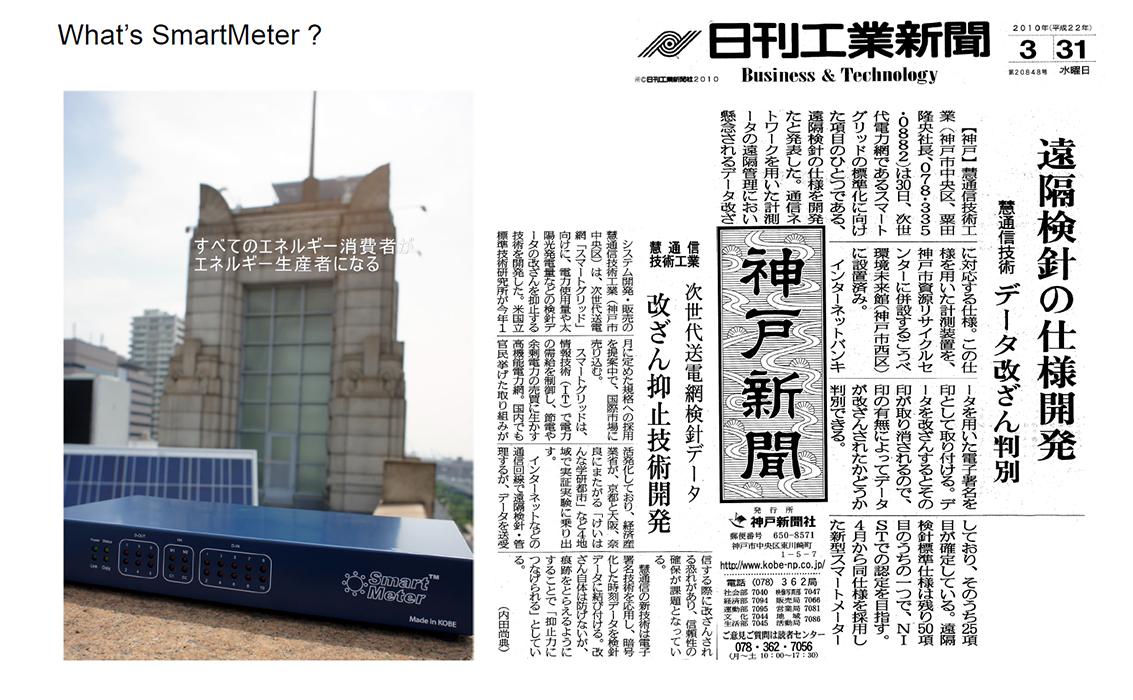
By 2010, Kei Communication Technology Inc. had developed its own smart meter, put it into the market, and begun collecting actual measurement data on a nationwide scale.
Through that work, we confirmed the following not only in theory but through real operating data:
- Temporal concentration and dispersion of demand
- Limits in response to price signals
- Structural constraints of supply-demand adjustment under centralized control
The observation showed that measurement and information have value by themselves, and that combining them with a primary power source and local control can turn observed conditions into action at the site.
From 2011, Kei Communication Technology Inc. therefore began developing, manufacturing, and selling off-grid systems that operate autonomously, distributively, and asynchronously.
Data from systems kept in continuous operation is returned to the next design.
Through the cycle of observation → verification → implementation → operation → redesign, off-grid architecture has been refined as a constraint-optimal solution.
VII. The Role of Off-Grid — Choosing Autonomy, Distribution, and Asynchrony
In this article, off-grid means an autonomous and distributed energy system that keeps the control point inside the system, changes state through local judgment, and can coordinate with other systems when necessary.
Its characteristics can be summarized as follows:
- The control point is explicit and close to the field.
- The system contains units that can act on local judgment.
- Those units can coordinate with other systems when needed.
- Failures can be contained within a small scope and recovery can proceed in stages.
- Expansion can occur by adding autonomous units.
- Operating conditions and human-intervention requirements can be made explicit.
The tighter the constraints of a location, the more valuable it becomes to retain a range within which decisions can be made on site.
Autonomy, distribution, and asynchrony are architectural principles for combining freedom of action with recoverability.
VIII. Conclusion — Choose the Optimal Structure from the Constraints
A microgrid has the power to coordinate, a smart grid has the power to observe and connect information, and off-grid has the power to decide and continue operating locally.
When these capabilities are combined at the right scale, one system can gain normal-operation efficiency, scalability, autonomy during failures, and easier recovery.
The clearer the constraints of long-term operation become, the more the design moves toward placing the control point closer to the field, retaining locally decidable units, and coordinating only when necessary.
Off-grid, with autonomy, distribution, and asynchrony, expresses those conditions in their most direct form.
For off-grid to converge toward a constraint-optimal solution means combining the strength of a large grid, the strength of information networks, and the strength of local autonomy while still retaining a domain in which the operator can make the final decision.
That design expands future choices.
Next: from design principle to implementation
Part 3 looks at how the design principles discussed here have been implemented through concrete components and control methods.
Using Personal Energy® as an example, it examines how autonomy, distribution, and asynchrony are translated into actual equipment.
References
- Smart Meter product information — Background on measurement, communications, and control implemented since 2010.
- US Patent 8,701,209 B2 — Patent record related to Kei Communication Technology Inc. smart-meter technology.
- Personal Energy® product information — An implementation example extending measurement and control into autonomous, distributed power.
- Primary measurement and operating data held by Kei Communication Technology Inc. — Primary data used to examine time-distributed demand, operating response, and control architecture.
Revision History
What Is Off-Grid? — Three-Part Series
- Part 1: Off-Grid Is a Design Architecture — Why We Define the Constraint-Optimal State as JIZAI
- Part 2: Off-Grid Converges toward a Constraint-Optimal Solution — Comparing Microgrids and Smart Grids by Control Architecture
- Part 3: How Off-Grid Is Implemented — Architectural Principles for Autonomous, Distributed, Asynchronous Energy Systems