
Key Point
The problem is not population decline itself. The problem is that systems designed for a much larger population remain in place after users, workers, and revenue decline.
Facilities, pipelines, roads, service networks, and operating obligations remain and continue to age. What appears to be maintaining the status quo often becomes a gradual decline in inspection, repair, transport, treatment, and delivery quality.
Smart shrink selects the functions that must not stop, removes unnecessary duplication, and strengthens the sites and systems that remain.
Demographic Shift / Demand Shift / Structural Change
1. Shrinkage Is Already Underway
Social contraction will not suddenly begin in 2040. Demand for children’s services is already falling while demand associated with aging is rising. Schools are consolidating, regional transport is reducing service, logistics providers are moving toward shared delivery, and healthcare and care services must support more demand with fewer working-age people.
Roads, bridges, water systems, ports, and public buildings also remain in service even as their user base declines. These are not unrelated problems in separate industries. They share the same structure: demand, labor supply, revenue, and maintenance capacity are moving in different directions.
Users, workers, tax revenue, and fee income decline, while facilities, networks, and service obligations built for a larger population remain.
Demand Shift
From Child-Centered Demand to Aging-Related Demand
Changes in diaper production are one visible indicator of demographic transition. The narrowing gap between infant and adult products reflects a broader reallocation of demand across goods, facilities, services, and labor.
Source: Japan Hygiene Products Industry Association, adult diaper statistics
Source: Japan Hygiene Products Industry Association, infant diaper statistics
Schools / Public Facilities
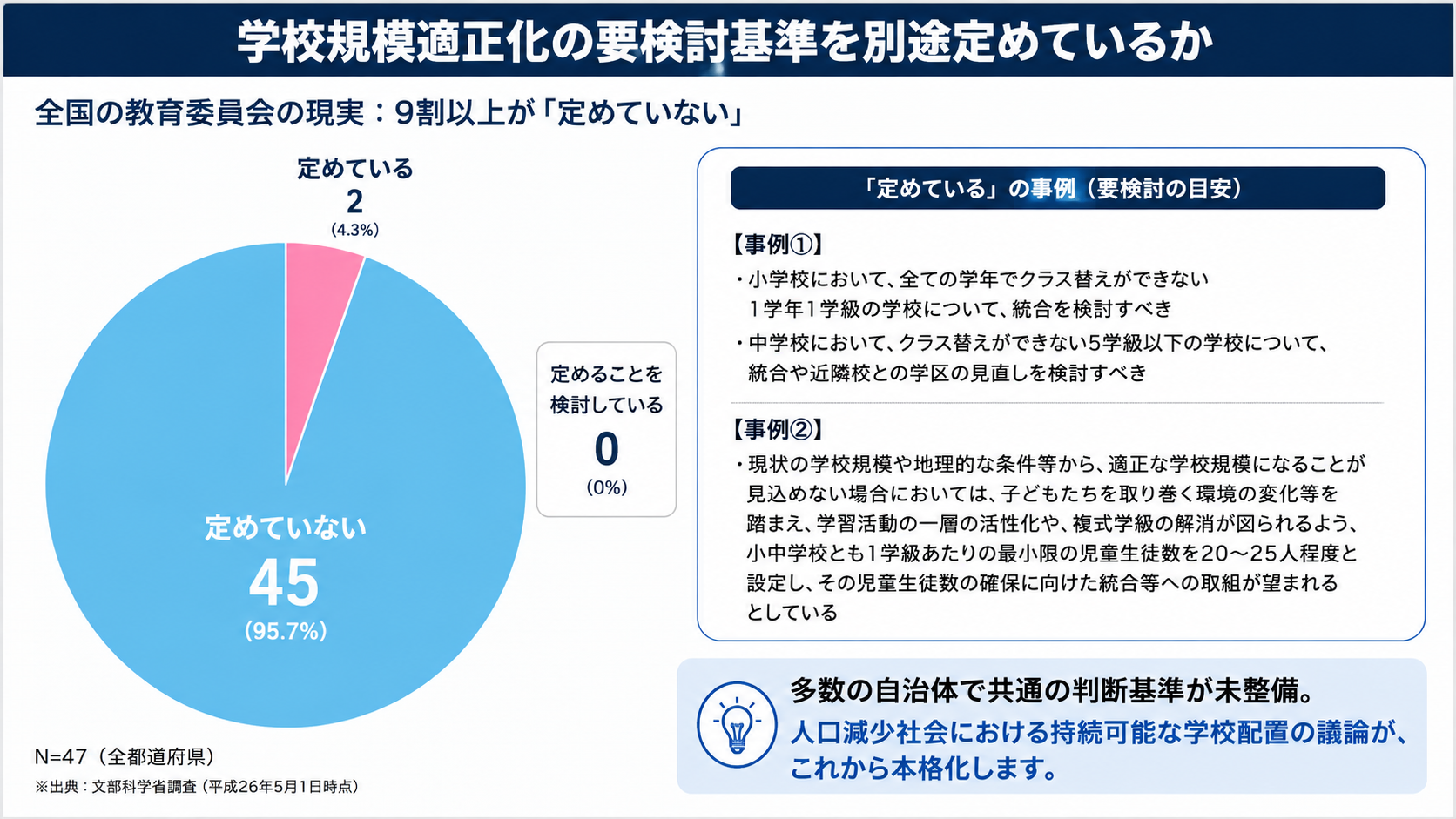
Fewer Children Change the Geography of Education
School consolidation affects more than classroom capacity. Travel time, school buses, local community roles, emergency shelter functions, food service, and child support must all be redesigned.
Source: Ministry of Education, Culture, Sports, Science and Technology
Transport / Logistics
Demand Can Remain Even When No One Is Available to Deliver It
Regional transport and last-mile logistics face simultaneous demand fragmentation and workforce shortages. Shared delivery, mixed passenger-and-cargo services, pickup points, drones, and delivery robots are not optional experiments; they are ways to preserve access.
Source: Ministry of Land, Infrastructure, Transport and Tourism, regional transport
Healthcare / Workforce
Care Demand Rises While the Working-Age Population Falls
Japan’s care workforce requirement is projected to rise substantially toward 2040. Healthcare and care must compete for workers with transport, logistics, construction, maintenance, manufacturing, and government.
Source: Ministry of Health, Labour and Welfare, projected care workforce requirements
Infrastructure Aging
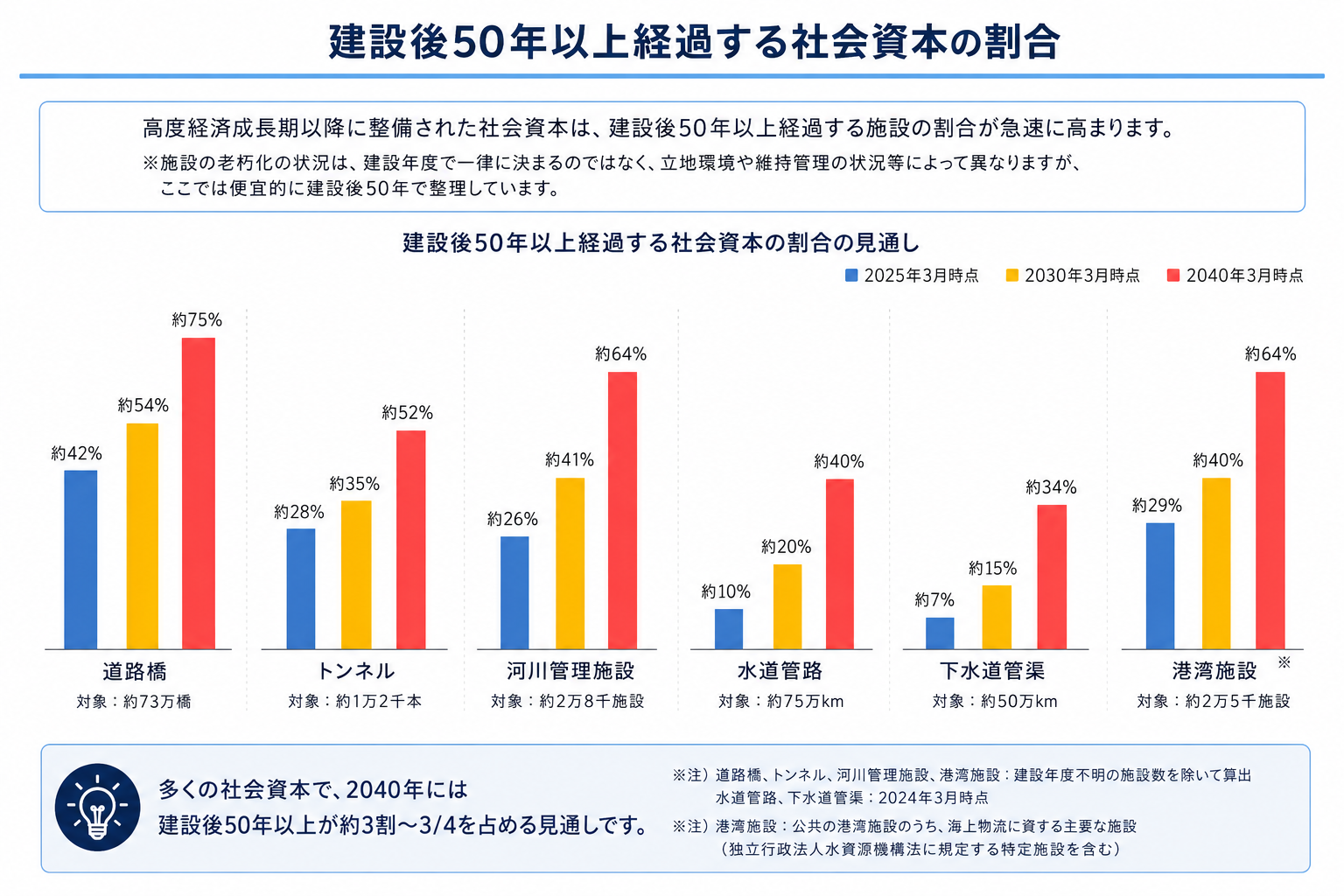
Aging Assets and Workforce Decline Overlap
By 2040, a large share of Japan’s roads, tunnels, river facilities, water networks, sewer systems, and port assets will be more than 50 years old. The number of assets requiring inspection, repair, renewal, or replacement will increase while the technical workforce available to perform that work declines.
Source: MLIT, current and future aging of social infrastructure
Schools / Consolidation / Access
2. School Consolidation Does Not End When a Building Closes
Consolidating small schools can be rational, but schools also function as shelters, community centers, food-service points, child-support hubs, and symbols of local identity.
The design question is not how many buildings remain. It is whether children can still reach education safely and whether the consolidated facility has sufficient transport, HVAC, power, communications, and emergency capability.
Regional Transport / Last Mile / Access
3. Transport and Last-Mile Services Can Become Unsustainable Before Demand Disappears
The function to preserve is not a specific route or delivery method. It is access to hospitals, schools, shopping, medicine, and essential goods.
Move from fixed routes to demand-responsive transport, and from individual delivery to shared delivery and pickup hubs.
Medical / Care / Workforce
4. Healthcare and Care Lose People Before They Lose Buildings
A facility cannot operate without physicians, nurses, care workers, laboratory staff, and maintenance personnel. Service decline often begins with fewer clinic days, longer waits, narrower specialties, and reduced night coverage before the building itself closes.
Smart shrink in healthcare combines selected permanent functions with hub hospitals, home visits, mobile services, telemedicine, and regional transport so that limited staff can focus on work only people can perform.
Construction / Maintenance / Repair Capacity
5. Infrastructure Can Exist but Still Become Unrepairable
Roads, water, power, communications, HVAC, fire protection, and control systems require people and contractors who can inspect, diagnose, repair, and restore them.
The first sign is usually not total failure. It is slower estimates, refusal of small jobs, no remote-area service, multi-week repair waits, and the disappearance of night and emergency response.
This is why condition monitoring, remote diagnostics, preventive maintenance, standardization, and remote expert support become essential.
Infrastructure Aging / Public Assets / 2040
6. By 2040, About Three-Quarters of Road Bridges Will Be Over 50 Years Old
Aging does not mean immediate failure at the 50-year mark. The problem is that inspection, repair, and renewal decisions for large asset classes will cluster in the same period.
Public Facility Management / Consolidation / Conversion / Removal
7. Public Facilities Must Be Retained, Combined, Converted, or Retired
Public asset management is no longer based solely on like-for-like replacement. It includes life extension, conversion, consolidation, multipurpose use, decommissioning, demolition, and seismic improvement.
Facility consolidation must also account for transport, backup sites, emergency shelter functions, and the power and communications capacity of the receiving facility.
Common Structure / Fixed Cost / Supply Capacity
8. Different Industries Share the Same Structural Problem
Schools, transport, logistics, healthcare, construction, and public facilities cannot shrink their fixed systems as quickly as their user base and workforce decline.
Trying to preserve everything usually means weakening everything a little at a time.
2040 Crisis / Workforce / Asset Renewal
9. The 2040 Crisis Is a Maintenance-Capacity Crisis
The central risk is not a lack of existing infrastructure. It is a lack of people and organizations able to operate, inspect, repair, and renew it.
Funding alone cannot solve a supply-capacity problem. A project cannot be delivered when there are not enough contractors, engineers, drivers, care workers, or public-sector staff.
Labor Supply Constraint
Japan May Face a Labor Shortfall Equivalent to About 11 Million Workers by 2040
Recruit Works Institute projects severe shortages across transport, construction, care, and healthcare. These are all services required to sustain daily life.
Definition / Smart Shrink / Rightsizing
10. What Smart Shrink Means
Smart shrink does not mean reducing every facility and budget equally. It means selecting the functions that must not stop and rebuilding the operating structure so those functions can continue with fewer people and resources.
Uncontrolled contraction
Functions disappear accidentally through retirement, business closure, failure, or disaster.
Smart shrink
Critical functions are selected while options remain, and alternatives, mobility, remote operation, and redundancy are prepared in advance.
Design Principles
11. Seven Principles of Smart Shrink
1. Do not protect everything at the same service level
Classify functions by whether they require zero downtime, can tolerate a short interruption, can be substituted, or can be ended.
2. Design around functions, not buildings
Preserve education, diagnosis, emergency communications, and water supply rather than treating the school, hospital, city hall, or plant as the unit of protection.
3. Consolidate scarce specialists and advanced equipment
Reduce duplication and concentrate 24-hour operations, specialist maintenance, spares, and analytics at core sites.
4. Protect consolidated functions through distribution
Distribute power, communications, data, monitoring, inventory, alternative procedures, and mobile equipment.
5. Keep systems operating until people arrive
Use no-break power, automatic transfer, local control, safe shutdown, and remote operation to bridge the response gap.
6. Move from patrols to monitoring and from reactive to preventive maintenance
Continuously collect signs of deterioration and narrow down which sites require field work and when.
7. Define exit conditions at the time of implementation
Set criteria for consolidation, conversion, or retirement based on users, maintenance costs, parts supply, contractors, and alternatives.
Critical Functions / RTO / Dependency
12. Start With the Functions That Must Not Stop
Protecting an entire hospital, city hall, or factory can make countermeasures too large to implement. Focusing on critical functions makes continuity design manageable.
| Sector | Examples of critical functions |
|---|---|
| Healthcare and care | Patient monitoring, medical gases, medical ICT, nurse call, refrigeration, communications |
| Government and disaster response | Emergency headquarters, disaster radio, resident data, shelter communications, water monitoring |
| Water and wastewater | Intake, pumping, distribution, pressure and quality monitoring, alarms, remote control |
| Logistics | WMS, inventory, receiving and shipping, labels, communications, cold chain, safety systems |
| Manufacturing | PLC, IPC, control power, communications, safety circuits, quality records, safe shutdown |
Concentration / Distribution / SPOF
13. Centralize Operations, Distribute Failure Risk
Consolidation improves the use of specialists and equipment, but it also increases the area affected when a core site fails.
Centralize
Specialists, advanced equipment, high-volume processing, procurement, monitoring work, analytics, and back-office functions.
Distribute
Power, communications paths, data replicas, monitoring methods, alternative sites, spare inventory, and mobile equipment.
Reduce unnecessary duplication in normal operations, but preserve alternative capacity for disruption.
Power / Communication / Data / Monitoring
14. Four Forms of Distribution That Prevent a Core Site From Becoming a Single Point of Failure
Distribute power
Separate critical loads and combine no-break power, batteries, generators, solar, and mobile power according to tolerable downtime.
Distribute communications paths
Combine fixed, mobile, carrier-diverse, and satellite connections, and verify physical path diversity rather than relying on contract diversity alone.
Distribute data
Support local use during network failure and remote recovery if the local site is lost.
Distribute monitoring and maintenance knowledge
Use monitoring with independent power and communications, multiple notification recipients, and shared drawings, settings, and failure history.
Implementation Steps
15. How to Implement Smart Shrink
- Identify critical functions. Organize by water supply, diagnosis, communications, monitoring, receiving, and shipping rather than by facility name.
- Set maximum tolerable downtime. Classify functions into zero seconds, minutes, hours, or more than one day.
- Map dependencies. Include power, communications, HVAC, water, personnel, transport, and external contractors.
- Identify single points of failure. One UPS, one circuit, one qualified person, or one maintenance contractor may all be SPOFs.
- Decide what to centralize, distribute, and substitute.
- Design for the period before people can arrive. Include nights, disasters, road closures, and multiple simultaneous failures.
- Build in monitoring and records. Preserve start times, trends, actions, and operating history as primary data.
- Define exit conditions. Establish criteria for consolidation, conversion, and retirement.
Article Network / System of Systems
16. Social Functions Cannot Be Sustained Through Isolated Optimization
Population decline, healthcare, transport, logistics, power, communications, AI, and maintenance are connected. Consolidating a hospital increases the importance of transport, communications, and emergency power. Reducing public facilities increases the need for mobility and alternative sites. Remote monitoring and AI still depend on field power and communications.
Smart shrink therefore requires a system-of-systems perspective that connects people, facilities, transport, logistics, power, communications, data, and maintenance.
Conclusion
17. Keep Critical Functions Running Even as Society Contracts
Population decline may be unavoidable, but the way social functions disappear is still a design choice.
If every service is preserved thinly, inspection, repair, treatment, transport, and delivery quality all deteriorate together. Selecting critical functions, removing unnecessary duplication, concentrating people and budgets, and distributing power, communications, data, and monitoring can create a system that continues with fewer people.
The choice is whether to shrink deliberately while options remain, or to be forced into contraction through failures and withdrawal.
Investment / Productivity / Growth
Population Decline Is Not a Reason to Stop Investing
Smart shrink is not retreat. It removes unnecessary duplication and concentrates investment in the functions society intends to preserve.
FAQ
Frequently Asked Questions
Q1. What is smart shrink?
It is the redesign of facilities, operations, power, communications, and maintenance around critical functions that must continue with fewer people.
Q2. How is it different from cost cutting?
Its goal is not merely lower spending. Its goal is to restore the ability to sustain essential functions.
Q3. Is consolidation enough?
No. Consolidated sites require distributed power, communications, data, and alternative equipment so they do not become single points of failure.
Q4. Does remote monitoring eliminate people?
No. It helps determine which assets require field work and when, allowing limited specialists to focus on the most important cases.
Q5. Where should an organization begin?
Identify critical functions, tolerable downtime, dependencies, single points of failure, and available alternatives.
Review Critical Functions Through Power, Communications, and Monitoring
We support governments, healthcare and care facilities, factories, logistics sites, communications infrastructure, and unmanned facilities in identifying critical functions, maximum tolerable downtime, power SPOFs, remote monitoring requirements, mobile UPS configurations, and off-grid power options.
Rather than overprotecting an entire facility, we identify critical loads and combine no-break power, extended runtime, mobility, and monitoring. Discuss a smart-shrink configuration