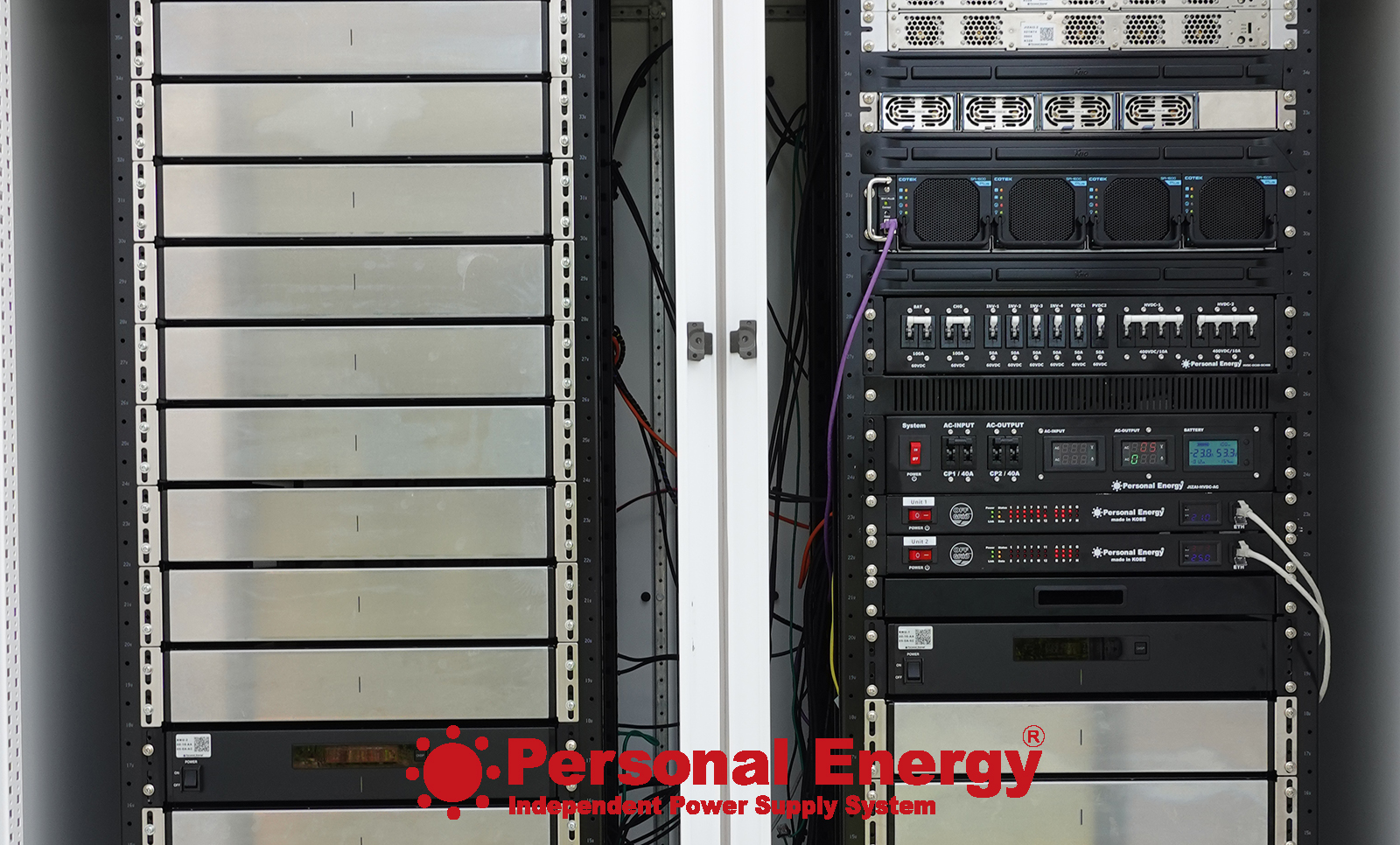
I. Turning a Design Principle into an Operating Architecture
Here, the JIZAI state defined in Part 1 and the control architecture discussed in Part 2 are translated into an energy system that actually operates.
The form of implementation is determined by the accumulated choices of which constraints to accept as design conditions and where autonomy should be placed.
Part 1 described off-grid as a JIZAI design that places the energy control point where the operator’s intent can reach it.
Part 2 compared microgrids, smart grids, and off-grid as control architectures and examined the scale at which coordination, observation, and local autonomy should be combined.
This article explains how those design principles were implemented as a concrete architecture by turning technical constraints into design conditions one by one.
Implementation is more than arranging components. It is the design act of deciding, from real environmental conditions, what should be autonomous, what should be distributed, and how much can operate asynchronously.
II. Starting in an Era When New Technical Possibilities Were Opening
Validation of the off-grid system that became the prototype for Personal Energy began around 2008.
It was a period when technical options were expanding rapidly and there was room to define design conditions ourselves.
For lithium-ion batteries, for example, conditions such as the following were still being established in real industrial operation:
- large-capacity deployment
- mass production
- long-term reliability for industrial use
To create a primary power system that could operate 24 hours a day, 365 days a year, over a ten-year timescale, it was therefore necessary to consider not only performance figures but also life, replacement, maintenance, and control as one integrated design.
Likewise, technology for millisecond-scale measurement and control of high current and high voltage was just before a major expansion in implementation freedom. Large-scale solar power was also about to enter the market. As new technologies moved into practical use, it became possible to verify in the field which combinations could support long-term operation.
We therefore placed the ability to operate the energy system as one architecture over the long term ahead of the performance of any single component.
Once ten-year operation was set as a design goal, required functions, control granularity, and maintenance philosophy became concrete one by one.
III. Turning Constraints into Design Conditions
The system began by defining the constraints required for operation to work in the real world.
Making the constraints explicit first clarifies the required functions and lets the architecture converge toward a concrete form.
The explicit constraints were:
- Continue local operation regardless of grid condition.
- Complete state transitions under local control.
- Continue operation without continuous human presence.
- Use the same architecture continuously from normal to emergency conditions.
- Withstand 24/7 operation on a ten-year timescale.
These are design conditions for operating continuously, 24/7, over a ten-year timescale.
Meeting them one by one turned autonomy, distribution, and asynchrony from principles into an implementable architecture.
IV. Defining the System as an Autonomous Distributed System
There are multiple definitions of an autonomous distributed system. For this article, the following expression is the most concise:
“A structure in which each element of the system acts while retaining its own autonomy, and order emerges at the system level through mutual coordination.”
This concept was proposed from the late 1970s and applied in actual systems in railways, steel production, and industrial control from the 1980s onward.
It is therefore a mature concept with early examples designed from the outset as a System of Systems.
Applied to electric-energy infrastructure, at least three implementation requirements become essential:
- How the primary power source is obtained
- Whether autonomous operation and fail-safe behavior independent of internal and external systems can be established
- Whether the system can withstand 24/7 continuous operation on a ten-year timescale
This system was designed on the premise that all three requirements must be satisfied.
From those requirements, the concrete components and control methods were determined.
V. Overall System Architecture
At an abstract level, the complete system consists of:
- Primary Power Source
- Energy Buffer
- Load Priority / Load Control
- Local Autonomous Control
Each element is given local decision-making capability, and only the necessary information is exchanged among them.
Instead of gathering everything at one large control point, autonomous units are layered to create an architecture that can move flexibly as a whole.
Implementing off-grid, autonomy, distribution, and asynchrony in energy is similar to the historical shift in computing from centralized office computers to personal computers.
This idea led to the development code name “Personal Energy.”
The goal was an energy system like the personal computer: each unit has its own role while remaining able to connect with others.
VI. Primary Power and Load Control
Solar power was selected as the primary source because it is available almost anywhere on Earth and is relatively less exposed to geopolitical supply risk.
Variability from weather and seasons was built into the design from the beginning, using primary generation data collected nationwide through smart-meter deployment.
Batteries are arranged as energy buffers to smooth that imbalance, with a High / Middle / Low hierarchy according to electrochemical characteristics.
Combining buffers with different time scales creates a structure that can absorb variation from daily cycles through seasonal cycles.
Load control implements a form of control based on knowing what is sufficient.
The system accurately identifies its present state and converges load toward the energy actually available at that moment. Forecasts and actual measurements are used appropriately so that the energy on hand is used as effectively as possible.
Protocol differences on the load side are absorbed by the off-grid side.
This allows the architecture to keep using common off-grid rules for energy management even as the number of connected devices increases.
VII. Control Principle: Autonomy, Distribution, and Asynchrony
The control philosophy of this system can be summarized in three principles.
Autonomy
State transitions are completed from conditions inside the system so that each unit can judge and act for itself within a permitted range.
Each unit can observe its own state and choose its next action without continuous human intervention.
Distribution
Each element has an independent decision axis and operates as a unit within which failures can be contained.
If one part stops, the remaining units can continue their roles, allowing overall function to be maintained in stages.
Asynchrony
Each unit judges its state on its own time axis and operates within its allowed range.
Accumulating local decisions produces a structure that remains stable as a whole and follows changing conditions.
Autonomy, distribution, and asynchrony are design principles grounded in control theory and distributed-systems theory.
Off-grid applies those principles to energy and gives each site a range within which it can decide for itself.
VIII. Why the Architecture Can Withstand Long-Term Operation
The reasons are simple:
- Control logic is simple.
- There are few external variables.
- The architecture localizes failures.
- The scope of maintenance and inspection is limited.
The design goal is continuous operation on a ten-year timescale without assuming permanent human presence.
Fifteen years passed from the start of Personal Energy operation in 2011 to 2026, and the philosophy of designing for long-term operation has accumulated through implementation and maintenance experience at multiple sites.
Component replacement and inspection are also built into a maintenance cycle anticipated as part of the architecture.
Including maintenance in the design keeps the control logic and hardware at a necessary and sufficient level and creates a condition in which the system can continue to be used for a long time.
IX. Relationship to Smart Meters and Smart Grids
Within this system, smart meters and smart grids are positioned as follows:
- Smart meter: Observation Layer
- Smart grid: Auxiliary Control Concept
- Off-grid: Foundational Architecture
Kei Communication Technology Inc. developed and deployed smart meters from 2010 through 2015. During that process, large-scale primary data accumulated that could track demand, generation, and power quality over time.
With advances in machine learning and computing resources after 2018, these data became easier to use as assets supporting optimal off-grid system design.
Observing the state and converting that observation into action through local control is one of the strengths of off-grid architecture.
X. Personal Energy as a Product Architecture
Beginning with BMS576, launched in 2011, the system evolved step by step.
The current JIZAI architecture has been applied to factories, logistics sites, and small community-scale off-grid projects.
Portable UPS systems are derived, simplified implementations of these off-grid systems.
They translate the same design principles of autonomy, distribution, and asynchrony into a portable form suited to different applications and scales.
JIZAI and portable UPS systems share the same autonomous, distributed, asynchronous architecture.
Implementing that structure for each use case turns the ideas of factories that do not stop, logistics sites that do not stop, and communities that do not stop into concrete equipment.
XI. Conclusion — Every Energy Consumer Becomes an Energy Producer
Off-grid is a design process that builds a structure capable of stable long-term operation from real constraints.
The more accurately the conditions are defined, the clearer it becomes what should be autonomous, what should be distributed, and on what time axis it should operate.
The result is a necessary-and-sufficient structure that can be used for a long time.
One implementation of that structure is the family of systems we call Personal Energy.
Personal Energy is a transformation device for the reversal in which “every energy consumer becomes an energy producer.”
Instead of remaining only on the side that is connected to centralized infrastructure, users move toward producing, controlling, and sharing energy themselves.
We use the word off-grid to describe that structural change.
References
- Smart Meter product information — Background on measurement, communications, and control since 2010.
- US Patent 8,701,209 B2 — Patent record related to Kei Communication Technology Inc. smart-meter technology.
- Personal Energy® product information — An implementation example of autonomy, distribution, and asynchrony applied to a power system.
- Development and operating records held by Kei Communication Technology Inc. — Primary records covering validation from around 2008, implementation from 2011, long-term operation, and maintenance.
Revision History
What Is Off-Grid? — Three-Part Series
- Part 1: Off-Grid Is a Design Architecture — Why We Define the Constraint-Optimal State as JIZAI
- Part 2: Off-Grid Converges toward a Constraint-Optimal Solution — Comparing Microgrids and Smart Grids by Control Architecture
- Part 3: How Off-Grid Is Implemented — Architectural Principles for Autonomous, Distributed, Asynchronous Energy Systems