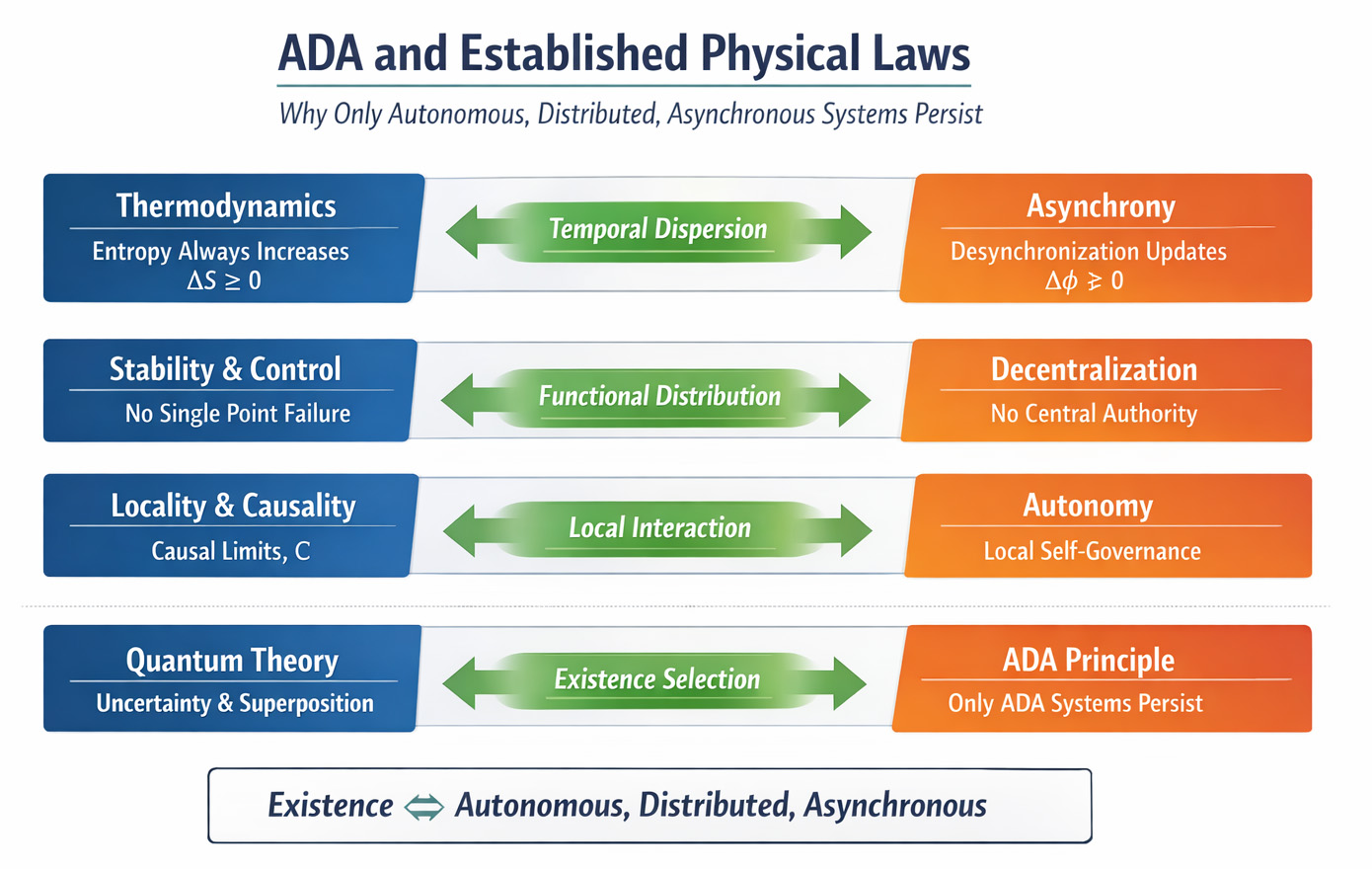
1. Disconnection can be treated as a design condition
The places in which we operate are different by nature: distance, communication conditions, institutions, organizations, decision authority, available resources, and time horizons.
If those differences are defined as design conditions from the beginning, it becomes easier to build a structure that matches reality instead of forcing the whole system to share a single premise.
- Technical distance created by different communication speeds and connection conditions
- Geographic distance created by disasters and terrain
- Organizational roles that differ between headquarters, field sites, and companies
- Differences in operating conditions created by borders, regulation, institutions, and standards
Because these differences exist, we can define the capabilities each site actually needs.
How much should it be able to decide for itself? What resources should it keep locally? When does information need to be shared?
Those questions are where the design of autonomy, distribution, and asynchrony begins.
2. A design that tolerates disconnection keeps its assumptions separate
Connectivity, sharing, and the ability to see the whole from the center are powerful capabilities.
If we make full use of them while also giving each site the ability to continue on its own, the system as a whole gains more options.
- Share information over the network during normal operations
- Complete necessary decisions locally
- Keep a defined amount of necessary resources at each site
- Record information and instructions in a form that can be reconciled later
With this structure, time that would otherwise be spent waiting for the whole system to reach the same state becomes time in which each site can act.
The ability to move without full synchronization is useful in both emergencies and normal operations, and supports faster decisions and stronger field capability.
3. Autonomy -- Give the local site the ability to decide
3-1. Definition
Autonomy means that a field site, facility, device, operator, or system can observe its own state, make decisions, and continue acting within its assigned scope of responsibility.
3-2. The freedom autonomy creates
- Decisions can be made closest to the actual conditions
- Critical work can continue locally
- Decisions and results can be recorded for later explanation and verification
In autonomous design, it is important to delegate authority together with responsibility.
By defining in advance what may be decided locally, when a decision must return to a higher level, and what must be recorded, the field can act with confidence.
4. Distribution -- Let each site support the whole
4-1. Definition
Distribution means placing functions, decisions, data, and resources across multiple units that can operate autonomously.
When each unit has a role, the system as a whole gains multiple ways to move.
4-2. The options distribution creates
- Some sites can begin operating before others
- Configurations can vary by region and purpose
- Recovery and expansion can proceed in stages
- Multiple local optimizations can be accumulated
Distributed sites become a flexible network when they hold their own roles as units that can operate independently and connect when needed.
5. Asynchrony -- Turn differences in timing into an advantage
5-1. Definition
Asynchrony means allowing information sharing, decisions, and execution to proceed on the time horizon appropriate to each unit, and reconciling them when necessary.
5-2. The freedom of time created by asynchrony
- The field can move first when action is needed
- Information can be recorded and shared or verified later
- Recovery and updates can proceed according to the condition of each unit
With asynchrony, differences in timing become design space.
Instead of requiring everyone to be in the same state at the same moment, each unit advances its own role and reconnects later.
6. Designing for disconnection increases design freedom
Once we accept from the beginning that conditions differ by region and organization, we no longer need to force everything into the same equipment, the same rules, or the same clock.
We can choose the capabilities each place needs and gain the freedom to combine autonomy, distribution, and asynchrony.
- Autonomy: place decision capability where it is needed
- Distribution: place functions and resources across multiple units
- Asynchrony: let each unit operate on its own time horizon and reconcile later
Combining these three principles makes it possible to design local freedom and overall connectivity at the same time across equipment, communications, logistics, organizations, and other domains.
7. System of Systems -- Independent systems create greater value by connecting
A System of Systems (SoS) is an approach in which multiple independent systems retain their own objectives and capabilities while cooperating to create larger functions.
The important point is that the components first function as independent systems and then cooperate.
Because each system has its own role, the whole can accommodate rearrangement and expansion.
- Each system behaves autonomously
- Functions are distributed
- Information and decisions move asynchronously
- Systems cooperate at necessary interfaces and create new capabilities as a whole
Social infrastructure, transportation, energy, logistics, and smart cities can all be designed from this perspective as cooperation among autonomous systems.
8. As the world becomes more diverse, local autonomy becomes more valuable
The internet has made it possible to share information around the world almost instantly.
Its benefits remain enormous and will continue to expand the possibilities for people and sites that are far apart to work together.
At the same time, institutions, cultures, energy conditions, supply chains, and disaster risks differ by region.
To make use of that diversity, it is more natural to interconnect while preserving the ability to decide locally than to force the whole system into a single set of conditions.
The more autonomous sites there are, the less society depends on a single answer and the more approaches it can try.
Ideas developed in one place can be shared and improved elsewhere. Distribution can also increase the learning speed of society as a whole.
9. Conclusion -- Design a society that can move before everything aligns
Combining autonomy, distribution, and asynchrony allows each site to operate according to its own conditions and connect with other sites when necessary.
- Autonomy increases the number of places that can make decisions
- Distribution increases the number of sites that can act and the number of available options
- Asynchrony secures the time each unit needs
Move from a world that waits until everything is aligned to a world in which each unit keeps moving and connects when needed.
This idea can be extended from energy to supply-chain management, information systems, regional infrastructure, and organizational design.
Designing for disconnection increases the range in which we can decide for ourselves, the methods we can try, and the options available for the future.
References
- ISO/IEC/IEEE 21839:2019 -- Systems and software engineering -- System of systems (SoS) considerations in life cycle stages of a system -- Reference for the standard positioning of a System of Systems.
-
Design Principles for Escaping the Boiling-Frog Trap -- A System of Systems (SoS) Overview
Background on SoS as cooperation among independent systems and on extending autonomy, distribution, and asynchrony to social systems.