1. Australia has the conditions to implement a large-scale energy transition
Australia has strong solar and wind resources, large land areas, and mineral resources, creating conditions for large-scale renewable-energy development. The government has set a target of supplying 82% of electricity from renewable energy by 2030 and is advancing investment in generation and storage.
At the same time, rooftop solar, grid-scale batteries, large wind and solar projects, and transmission reinforcement are all progressing, creating the scale required to update the power system itself.
That is why Australia is a valuable case in which large energy targets can be observed all the way through the question of how they are actually built.
2. Net Zero Australia -- Timing moves when assumptions change
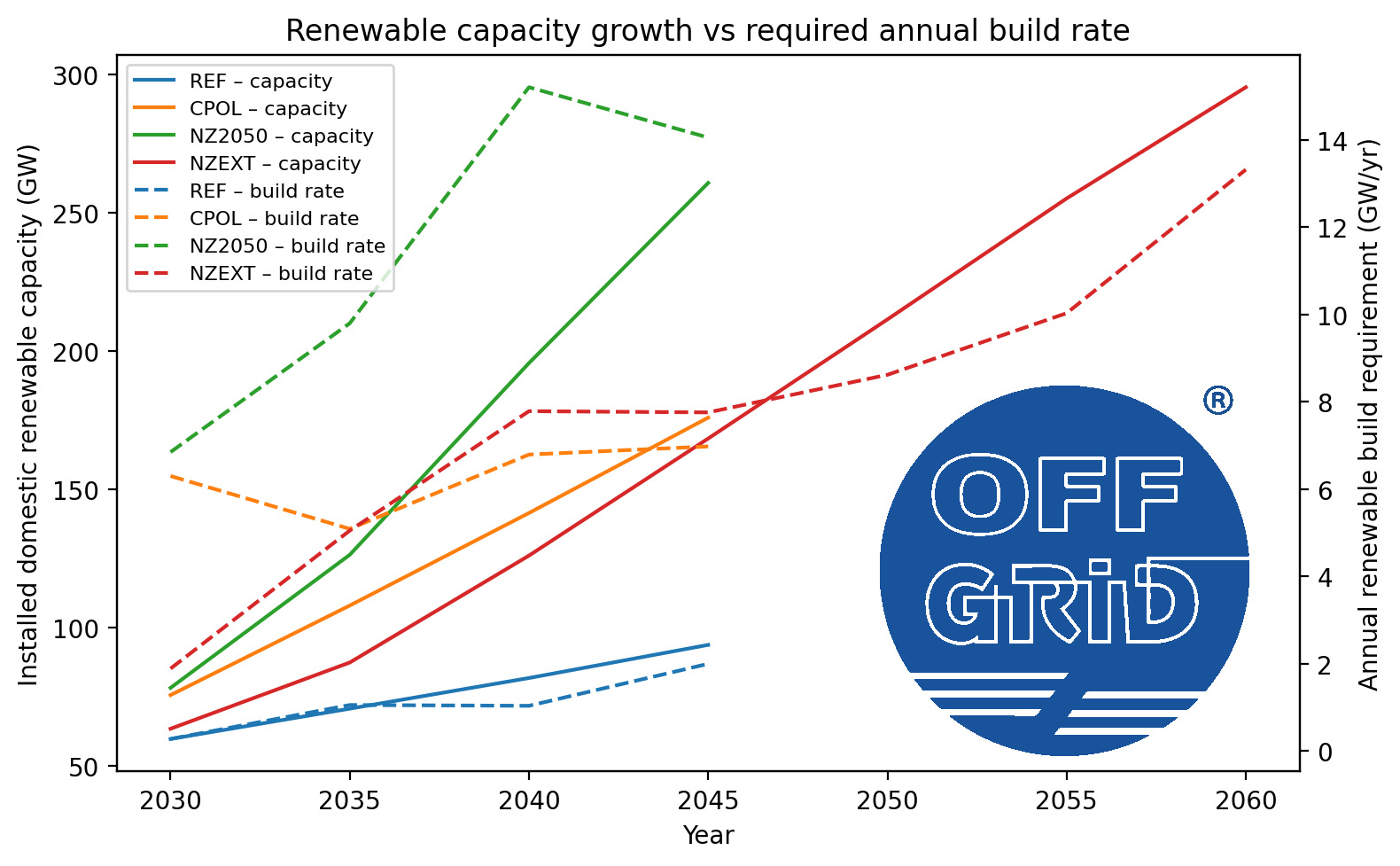
Net Zero Australia (NZAu) is a research project involving the University of Melbourne, the University of Queensland, Princeton University, and others. Its 2025 updated model compares multiple pathways by changing conditions such as policy, equipment investment, and annual build capacity.
| Scenario | NZAu view around 2030 |
|---|---|
| Current Policies | About 59% renewables in 2030 |
| Net Zero 2050 | About 2033 to reach 82% renewables |
The important point is that the completion date is not treated as one fixed number. Change policy, annual construction capacity, electrification speed, or investment conditions, and the timeline changes as well. The model can be used as a tool for translating a target into implementation conditions.
How to read "up to 10 years late"
The phrase "up to 10 years" was used in reporting at the end of 2025 in connection with development pipelines and longer planning and approval processes. NZAu's 2025 report presents multiple scenarios, including Current Policies and Net Zero 2050, with different arrival times.
3. AEMO -- Grid planning also designs the order of connection
The Australian Energy Market Operator (AEMO) treats generation, storage, and transmission as one power system in its long-term planning for the National Electricity Market. The Draft 2026 Integrated System Plan also considers cases in which equipment supply and construction speed are constrained.
Under its Constrained Delivery case, the timing of the 2030 target moves later, while the value of advancing transmission projects becomes greater. The more generation is added, the more important the network becomes for moving that energy between regions, balancing supply and demand, and connecting it to storage.
The energy transition is moving from a race to build power plants toward system design that connects generation, transmission, and storage in the right order.
4. Put the constraints side by side, and the next place to act becomes visible
Large wind and solar projects pass through many stages from concept to operation: land, environmental assessment, grid connection, financing, equipment procurement, construction, and commissioning. Each stage has its own lead time.
What needs to be developed centrally
- Long-distance transmission and grid connection
- Grid-scale and long-duration storage
- Market design and investment frameworks
- Wide-area supply-demand balancing
What regions and customers can advance locally
- Energy efficiency in buildings and factories
- On-site generation and storage for self-consumption
- Demand control and peak management
- Autonomous power for critical loads
Different workstreams can move in parallel toward the same target. Even while waiting for large central infrastructure, customers can generate and store energy locally and change how it is used. That is a major opportunity for distributed energy.
5. Delay becomes information for making the design more precise
When a time gap appears between plan and implementation, there is a reason: transmission completion dates, connection queues, equipment procurement, regional agreement, or workforce availability. Making each constraint visible shows where the next investment should go.
Large grids can move power over wide areas. Distributed energy expands the range in which buildings, factories, and regions can generate, store, and control energy locally. Combining both increases the number of possible transition pathways.
The gap between target and reality shows where the next intervention belongs.
It is design data that tells us which change can make the next step faster.
6. Thinking from Japan -- Design so progress can continue during the waiting time
Japan and Australia differ in land, electricity markets, grid structure, and institutions. Australia\'s completion dates therefore cannot be applied directly to Japan.
Transmission still takes time to build, large infrastructure still requires permitting, and workforce and materials still have supply limits. The general principle is reusable: the larger the target, the earlier physical lead times should be incorporated into the design.
Viewed from buildings, factories, and customers, this timeline allows central-grid renewal to proceed in parallel with local generation, storage, efficiency improvement, and autonomy. Moving multiple time horizons at once brings an energy transition closer to implementation.
References
-
Net Zero Australia -- Updated Net Zero Pathways for Australia, Topical Report #1
Primary research comparing the 2030 renewable share and timing for reaching 82% across multiple scenarios.
-
AEMO -- Draft 2026 Integrated System Plan
Grid planning for the optimal development path of generation, storage, and transmission, including equipment-supply and construction constraints.
-
Australian Government -- Development pathway for Australian renewable energy projects
Commercial and regulatory processes through which large renewable projects pass from concept to operation.