1. Turn the "10-year gap" into usable time on the customer side
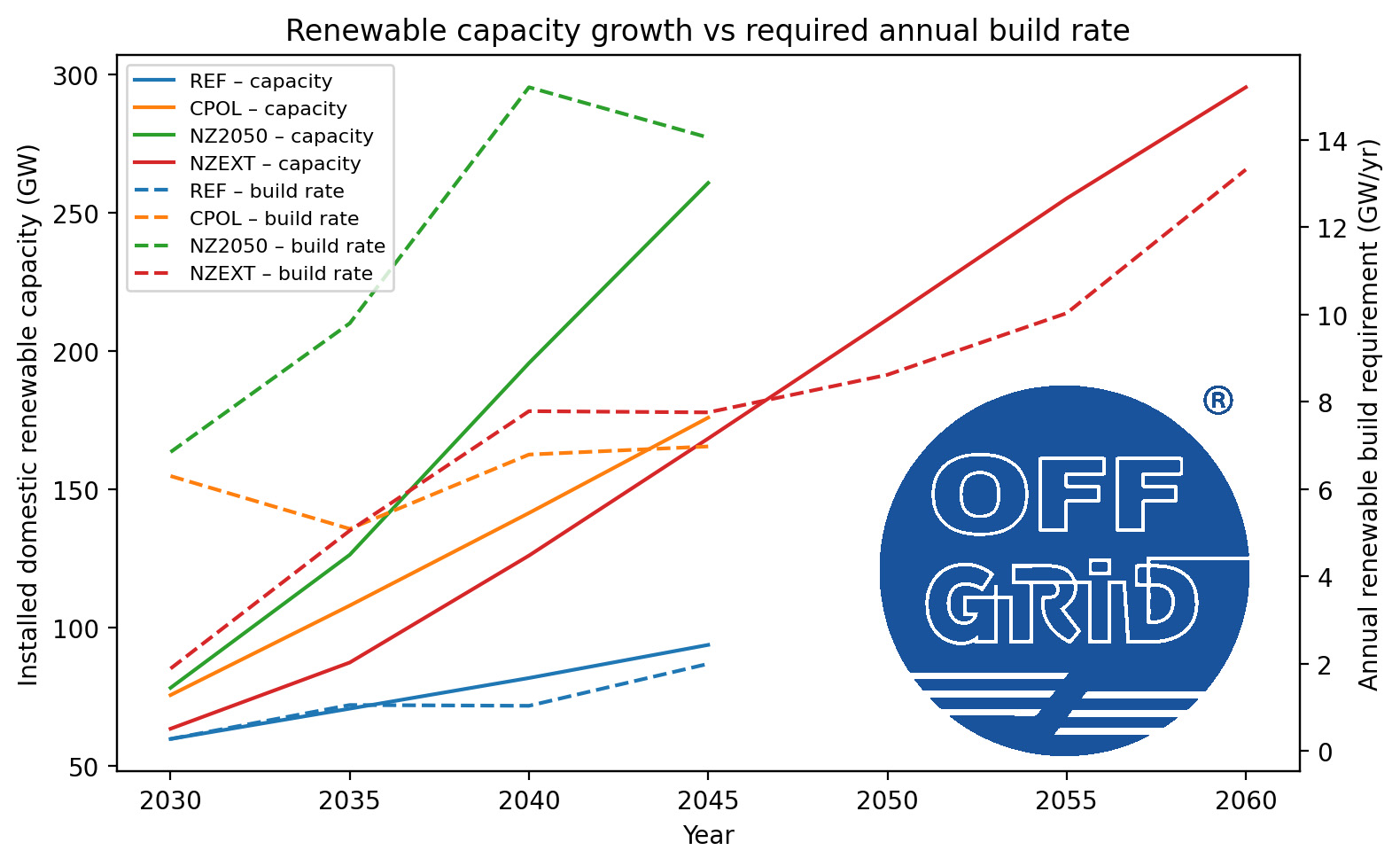
The speed of a renewable-energy transition is determined by implementation capability, including generation, transmission, storage, permitting, workforce, materials, and regional agreement.
Viewed from the customer side, the same timeline looks different. Large transmission infrastructure has long lead times, but buildings and factories can begin measurement, operational improvement, rooftop PV, batteries, demand control, and process renewal in stages.
Move the time for building large infrastructure and the time for changing the field in parallel.
With these two time horizons, the energy transition expands from one process into multiple processes.
2. Buildings gain generation, storage, and demand control
Net Zero Australia treats buildings as a distinct analytical sector and models energy efficiency, fuel switching, rooftop PV, and battery adoption by region. Buildings move from places that receive electricity to places that can generate, store, and choose when to use it.
Generate
Produce energy at the point of demand with rooftop PV and on-site generation.
Store
Shift energy in time through batteries and EVs, connecting day with night and normal operation with outages.
Choose when to use
Move flexible loads such as HVAC, water heating, and charging to shape demand peaks.
AEMO's 2026 Integrated System Plan projects 116 TWh in 2050 from consumer energy resources (CER) and mid-scale distributed resources. Rooftop PV, batteries, and EVs are customer-owned equipment, but they are also treated as components that affect supply and demand across the wider power system.
3. Factory energy efficiency begins by redesigning the process
In manufacturing, improving the efficiency of individual machines can already produce benefits. But when the whole process is measured on the same time axis, relationships among heat, pressure, motors, HVAC, compressed air, standby loads, and peak electricity become visible.
Australian Government guidance for manufacturing also identifies optimization of existing equipment, real-time measurement, and benchmarking as ways to improve energy efficiency. The Net Zero Fund, whose design was finalized in 2026, also targets investment in energy-efficiency improvement and lower-emission processes at large industrial facilities.
- Measure electricity and heat demand by process
- Review the timing of processes that create peaks
- Improve the efficiency of heat sources and drive systems and electrify them where appropriate
- Combine rooftop PV, storage, and on-site generation with process loads
- Give autonomous power to control, communications, and recovery loads that should not stop
A factory moves from a place that merely "buys and uses energy" to a place where the process and the power system are designed together.
4. More local control points create more options
The strength of buildings and factories is that equipment and loads are in the same place. On site, generation, stored energy, loads, and operating state can be observed together, allowing decisions that fit local conditions.
Control that can be held locally
- When to charge and discharge
- Which loads to prioritize
- Which processes can be shifted in time
- What should remain during an outage
- In what order loads should return after power is restored
The value added by off-grid architecture is to create a range in which critical functions can continue under local control. Giving autonomy first to the necessary scope increases the number of actions available to the field.
5. The central grid and distributed energy are two implementation paths toward the same future
Large transmission networks can move power across regions. Grid-scale storage and wide-area balancing also play important roles in stable operation across society.
At the same time, distributed energy in buildings, factories, and communities can advance generation, storage, and control at the point of demand. Moving both paths in parallel develops the ability to support one another across wide areas and the ability to operate autonomously locally.
Rather than waiting for one enormous system to be completed, accumulate many smaller completions across many places.
When those units connect, they form a larger energy system.
6. Starting in Japan -- First find the range you can move yourself
Australia and Japan differ in grid structure, geography, industrial structure, and institutions. What can be shared is not a specific amount of equipment, but the order of implementation.
- Measure loads and understand when and where energy is used
- Separate loads whose timing can move from loads that should not stop
- Apply efficiency improvement, generation, storage, and demand control to the loads
- Give critical functions a period in which they can operate autonomously
- Feed operational data back into the next equipment renewal
The process can begin with one building, one factory line, or one communications site. Increasing the range that can be moved under your own control, one step at a time, turns the energy transition into work that can be carried out in the field.
References
-
Net Zero Australia -- Buildings, rooftop photovoltaics and batteries
Downscaling report covering building energy demand, efficiency and fuel switching, rooftop PV, and batteries.
-
AEMO -- 2026 Integrated System Plan
Long-term National Electricity Market plan including consumer energy resources, rooftop PV, batteries, EVs, and mid-scale distributed resources.
-
Australian Government -- General manufacturing
Practical manufacturing guidance on equipment optimization, real-time measurement, benchmarking, and other energy-efficiency measures.
-
Australian Government -- Net Zero Fund finalises design
Investment support for decarbonization, energy-efficiency improvement, and lower-emission manufacturing processes at large industrial facilities.