Key Points
Keeping logistics and manufacturing running does not require backing up an entire facility. The priority is to identify communications, control, authentication, and recovery loads whose loss would stop the site, then protect them reliably for the required period.
Do not confuse failure causes
Cyberattacks, outages, momentary interruptions, and communications failures are different events. Cybersecurity and power continuity are both required.
Protect priority functions, not just large loads
Prioritize WMS, Wi-Fi, PoE, PLCs, authentication, labels, and monitoring when their failure can stop the entire operation.
Set runtime from the recovery plan
Provide enough time for safe shutdown, generator startup, degraded-mode operation, or transfer to a temporary site.
Build portability into operations
Move the system between sites without fixed backup, maintenance work, statutory shutdowns, incident recovery, and temporary peak-season circuits.
Control Plane / Communications / Operational Continuity
1. Large Equipment Is Not the Only Thing That Can Stop a Site
Warehouses and factories naturally focus on large loads such as conveyors, refrigeration, machine tools, and material-handling systems. Yet the decisions, sequencing, authentication, and records required to operate them are often handled by communications and control devices with relatively small power demand.
Logistics
Warehouse operations
WMS terminals, handheld devices, wireless access points, PoE switches, routers, label printers, authentication, monitoring, and time synchronization.
Manufacturing
Production operations
PLCs, I/O power, industrial PCs, HMIs, sensors, communications gateways, quality records, and control networks.
When these devices reboot after a momentary interruption or voltage dip, the major equipment itself may remain undamaged, but sessions must be re-established, axes re-homed, data checked, users reauthenticated, and products re-inspected. This is how a power event lasting milliseconds becomes an operational outage lasting minutes or hours.
Power protection should be prioritized by the functions that spread disruption across the site when they stop, not simply by the loads with the highest wattage.
Cybersecurity / Power Continuity / Compound Failure
2. Cyberattacks and Power Failures Are Different Risks
During a major system incident, an organization may intentionally disconnect networks or servers to contain further damage. In that situation, operations stop because information systems have been isolated. A UPS cannot prevent that decision or the cyberattack that caused it.
Isolation, investigation, backup verification, device reimaging, identity reconstruction, and staged restart still require reliable power and communications. If an outage or momentary interruption occurs during recovery, investigation workstations, network devices, local servers, and communications may also stop, turning one incident into a compound failure.
What cybersecurity must provide
- Prevention and detection of intrusion or infection
- Identity, authorization, and network segmentation
- Backups and restoration
- Isolation, investigation, and evidence preservation
What power continuity must provide
- Prevention of additional shutdowns caused by outages or momentary interruptions
- Time for safe shutdown and data preservation
- Continuity for communications, authentication, and recovery workstations
- Support for staged restart and temporary operation
A portable UPS does not prevent cyberattacks.
Cybersecurity and power continuity are not substitutes. They complement each other by preventing different failure causes from stopping the same operation at the same time.
The wider structure by which logistics system failures spread through society is explained in "Modern Logistics Runs on Power and Information."
Priority Loads / Minimum Viable Operation / Safe Stop
3. Protect the Loads That Cannot Stop, Not the Entire Facility
Starting a power continuity plan by trying to operate an entire building for hours often produces an oversized system. First define which functions must remain available until full recovery and which functions are required for a safe stop.
| Priority group | Typical loads | Purpose |
|---|---|---|
| Communications | Routers, switches, PoE, wireless APs, alternate links | Maintain terminal access, communications, monitoring, and local operation |
| Information and identity | WMS terminals, local servers, authentication, time synchronization, labels | Maintain inbound and outbound records, authorization, and traceability |
| Control | PLCs, I/O, HMIs, industrial PCs, control networks | Reduce uncontrolled stops, lost synchronization, re-homing, and reinspection |
| Recovery | Investigation terminals, backup devices, communications, temporary equipment | Continue isolation, verification, restoration, and staged restart |
The same facility will have different priority loads and runtime requirements during normal operation, statutory shutdowns, natural disasters, cyber incidents, and equipment maintenance. The ability to reconfigure connections by use case is a core advantage of a portable UPS.
Portable / Retrofit / Temporary Operation / Multi-Site
4. Portability Expands Recovery and Operating Options
A fixed UPS is effective for circuits that require continuous protection. Logistics and manufacturing sites, however, often face risks that are not limited to one permanent location.
Retrofit to existing equipment
Add zero-transfer power to priority loads without a major facility modification.
Statutory shutdowns and maintenance
Maintain monitoring, communications, authentication, reception, and maintenance terminals while the main supply is unavailable.
Incident recovery and temporary sites
Temporarily power recovery teams, alternate communications, local servers, and label printing.
Peak seasons and layout changes
Move power protection as temporary work zones or equipment locations change.
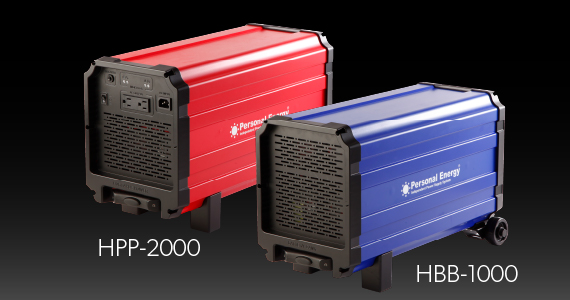
HPPHBB0101 is a two-unit system weighing approximately 70 kg, with retractable handles and casters. It is not a hand-carried consumer device. It is an industrial portable UPS designed to be moved within a site to the location where power continuity is required.
HPPHBB0101 / Zero Transfer / AGM / Expandable Runtime
5. Key Specifications of the Portable UPS HPPHBB0101
HPPHBB0101 is an industrial and commercial portable UPS consisting of the HPP2000 Portable Power unit and the HBB1000 Battery Bank.
| Transfer | Zero-transfer operation / bidirectional inverter UPS |
|---|---|
| Output waveform | Pure sine wave / THD 5% or less under linear load |
| Rated output | Up to 3,000 W load following while connected to utility power / 2,000 W on battery alone |
| Battery capacity | 1,600 Wh total AGM capacity (1.6 kWh) |
| Maintenance and expansion | Hot swap / linked battery-bank expansion |
| Input and output | AC 100 V grounded input / two AC 100 V, 15 A outlets |
| Operating temperature | -20°C to 50°C |
| Weight | Approximately 70 kg per set |
| Installation | No installation work required / retractable handles and casters |
Performance varies with configuration, load, input conditions, temperature, and battery condition. Compatibility and runtime must be engineered after confirming rated load, inrush current, and grounding requirements.
Zero Transfer
Zero-transfer operation
Maintains power to communications, control, and authentication loads that cannot tolerate transfer delay.
Non-Lithium AGM
AGM battery technology
Uses sealed AGM batteries rather than lithium-ion, simplifying storage and operational planning for industrial and public-sector use.
Hot Swap / Expansion
Maintainability and runtime expansion
Hot-swap capability and linked battery banks support maintenance and longer runtime without intentionally stopping the protected load.
Runtime / Load Profile / Recovery Window
6. Design 1.6 kWh as Time to Continue, Not Just Battery Capacity
Runtime is not determined by battery capacity alone. It changes with normal load, peak demand, startup power, efficiency, operating temperature, and battery condition.
Approx. 10 hours
150 W load
Approx. 5 hours
300 W load
Approx. 3 hours
500 W load
Approx. 1 hour
1,000 W load
These are reference values published on the product page and are not guaranteed runtimes. Actual runtime must be verified for the connected equipment, operating mode, battery aging, temperature, and load variation.
DESIGN FROM THE NEXT ACTION
Decide first what must be completed before asking how many hours the battery can run. The target may be 30 minutes for a safe stop, one hour until generator startup, five hours of degraded-mode operation, or ten hours until transfer to an alternate site. Runtime is a bridge to the next operational action.
Battery banks can be linked for additional capacity. Configuration limits, charging time, installation conditions, and maintenance procedures must be confirmed in the project-specific specification.
Applications / Logistics / Manufacturing / Recovery
7. Example Configurations for Logistics, Manufacturing, and Recovery
Warehouse Network
WMS, Wi-Fi, and PoE
Prioritize routers, PoE switches, wireless access points, and WMS terminals to reduce cascades of handheld reconnection and user reauthentication.
Control System
PLCs, industrial PCs, and HMIs
Power the control layer rather than the full motor load to reduce re-homing, lost synchronization, recipe reloads, and quality reinspection.
Recovery Cell
Temporary power for incident recovery
Temporarily power investigation terminals, alternate communications, local servers, label printing, and a recovery coordination point to support staged restart.
Example: priority circuit at a logistics site
Instead of attempting to run every refrigeration compressor or conveyor motor from batteries, separate and protect the information and communications circuits required to continue inbound and outbound operations or stop them safely.
Assessment / Electrical Conditions / Test
8. Eight Items to Confirm Before Deployment
1. Functions that cannot stop
Prioritize functions such as shipping, authentication, control, monitoring, and records rather than starting with equipment names.
2. Maximum tolerable downtime
Separate loads that cannot tolerate any interruption from loads that can be unavailable for minutes or hours.
3. Measured load and inrush
Measure normal operation, startup, and simultaneous restart instead of relying only on nameplate values.
4. Power system and grounding
Confirm AC 100 V, grounding, polarity, panel arrangement, residual-current protection, and conditions for connection to existing UPS systems.
5. Required runtime
Size the system from the time needed for safe shutdown, generator startup, degraded-mode operation, or relocation to an alternate site.
6. Installation and movement route
Confirm floor loading, steps, corridors, storage location, temperature, ventilation, and assigned operators.
7. Recovery sequence
Define the restart order for networks, identity, servers, terminals, controls, and operational work.
8. Real-load testing
Test outage transition, runtime, alarms, overload, return of utility power, and restoration to normal operation.
Scope / Limitations / Engineering Review
9. What a Portable UPS Cannot Solve by Itself
A power continuity plan is not complete simply because a UPS has been installed. The following loads and applications require project-specific review of the full electrical system, applicable regulations, and equipment-manufacturer conditions.
- High-capacity loads such as refrigeration, HVAC, large motors, and conveyor drives
- Equipment involving high inrush current, regenerative power, nonlinear loads, three-phase supply, or special grounding
- Fire protection, disaster response, medical, and safety systems subject to dedicated-power or statutory requirements
- Cyberattacks, communications-carrier outages, or cloud-service outages themselves
- Energy supply during extended outages, including fuel logistics, generators, solar power, and vehicle-to-load systems
The role of HPPHBB0101 is not to operate every load from one system. Its role is to protect selected critical loads and add a dependable period of continued operation.
Business Value / Avoided Downtime / Recoverability
10. Evaluate UPS Value by Avoided Loss, Not by the Number of Activations
A UPS is not an asset whose value should be measured only by how often it switches to battery. Its value includes avoided reboots, interrupted work, reinspection, mis-shipments, additional transport, customer communications, and emergency recovery labor.
Investment decisions should consider more than equipment price and battery capacity. Estimate gross margin at risk from one outage, recovery labor, disposal, late delivery, loss of trust, and effects on customers and partners. Even without a prior outage record, a loss range can be built from maximum tolerable downtime and the work required to recover.
The business value of power continuity includes both preventing the stop and returning safely and quickly after a stop occurs.
Conclusion
Conclusion: Power Is a Control Condition for Logistics and Manufacturing
Modern logistics and manufacturing do not use electricity only as motive power. Stable power is also the condition that keeps communications, authentication, control, records, and work instructions available.
Cybersecurity prevents and contains cyberattacks. Power continuity protects against outages and momentary interruptions. Operational design defines degraded-mode operation and recovery sequence. The three must be designed separately and then connected as one business continuity plan.
The portable UPS HPPHBB0101 provides zero-transfer power to communications, control, and recovery loads where they are needed, bridging the period until full operation can be restored.
Product Information / Technical Reference
Product Information and Related References
- HPPHBB0101 portable zero-transfer UPS product page
- Battery-bank connection and expansion
- Modern Logistics Runs on Power and Information
- Toward Zero Momentary Interruptions and Voltage Dips with a Portable UPS (Japanese article)
Key specifications and runtime references are based on the product information available as of July 16, 2026. Final configuration, connection conditions, warranty, and submission documents must be confirmed in the quotation, specification, and approved delivery documentation.
FAQ
Frequently Asked Questions
Q1. Can a portable UPS prevent a cyberattack?
No. Cyberattacks are prevented and contained through cybersecurity controls. A portable UPS protects communications, controls, and recovery terminals from outages and momentary interruptions during recovery, reducing the risk of a compound incident.
Q2. Which warehouse loads should receive priority?
Routers, PoE switches, wireless access points, WMS terminals, authentication, time synchronization, label printing, and critical controls required to continue inbound and outbound operations or to stop them safely.
Q3. Can it back up the entire facility?
HPPHBB0101 is suited to circuit-level protection of priority loads. Refrigeration compressors, large motors, and HVAC require separate engineering that may include generators and larger energy storage systems.
Q4. How many hours of backup does it provide?
Runtime depends on load. Product-page reference values are approximately 10 hours at 150 W, 5 hours at 300 W, and 3 hours at 500 W. Actual results must account for startup demand, temperature, and battery condition.
Q5. Is real-equipment testing required before deployment?
Yes. Test the actual load, inrush current, grounding, transfer behavior, runtime, return of utility power, and restoration to normal operation. This identifies compatibility and operational issues that cannot be confirmed from specifications alone.
Map Priority Loads Circuit by Circuit at Logistics and Manufacturing Sites
We assess WMS, Wi-Fi, PoE, PLCs, industrial PCs, monitoring, authentication, label printing, and recovery workstations, together with maximum tolerable downtime, measured load, inrush current, grounding, recovery sequence, and degraded-mode operation.
Rather than oversizing backup for an entire facility, we identify the functions that cannot stop and configure zero-transfer power, extended runtime, portability, and connection to generators or external power sources for the specific use case. → Discuss a power configuration for your logistics or manufacturing site