Designing for disconnection means ensuring that one failure or intrusion cannot reach everything. The same principle applies to corporate approvals, privileges, and internal controls.
What Did Convenience Remove?
Digitalization has made business faster. Decisions that once traveled through several management levels can now be delegated or executed through software. Yet some of those steps also offered opportunities to detect mistakes, question assumptions, or stop improper actions.
More approvals do not necessarily mean better decisions. Formalistic approvals may obscure accountability. The question is not simply what became faster, but which checks were removed in the process.
What Is Active Directory For?
Active Directory (AD) centralizes identities, computers, authentication, access rights, and configuration policies. It simplifies employee onboarding, access changes, and administration of large fleets of systems.
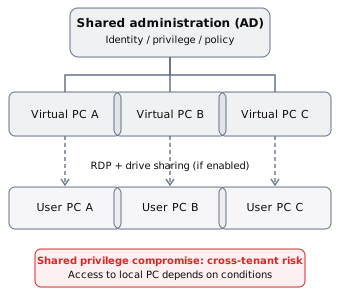
The broader the management scope, however, the more valuable privileged credentials become. Attackers targeting ransomware operations may seek AD or privileged accounts because they can reach many systems rather than attacking each one individually. The issue is not AD itself, but what an acquired privilege can reach.
The Assets Connected by Remote Work
Remote work expanded rapidly during the pandemic. Remote Desktop Protocol (RDP) does more than transmit a display: depending on settings, it can expose local drives and clipboard resources to the remote session.
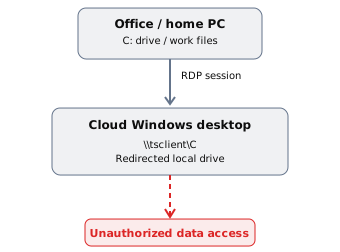
Consider a hypothetical provider hosting several virtual Windows desktops under a shared administrative framework. Compromise of common privileged access could expose multiple virtual environments. If an attacker can use an active RDP session with drive redirection enabled, files on the connecting computer may also become accessible. File access must be distinguished from malware execution on that computer.
Postponing the Inconvenience of Updates
PHP and Node.js have long maintained version and support lifecycles. Upgrades require compatibility testing, dependency checks, maintenance windows, and sometimes downtime and rollback plans. These tasks are inconvenient in normal operations.
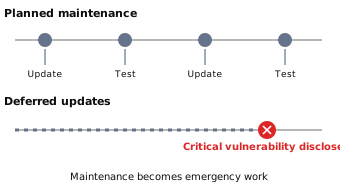
Deferring them does not eliminate the work. If a critical vulnerability first triggers a debate about whether a service can be stopped, planned maintenance has become emergency governance. Immediate upgrades are not universally appropriate; the key questions are who approved an exception, for how long, and with what compensating controls.
An External Audit Does Not Operate Internal Controls
When companies retain external auditors for financial reporting, everyday journal entries, payment approvals, segregation of duties, and asset controls remain management responsibilities. Being audited differs from operating the controls under audit.
The same holds for cybersecurity. A firm may commission a public-facing web vulnerability assessment without reviewing shared AD privileges, RDP redirection, contractor accounts, or retired assets. Executives need to know not only the audit outcome but also its scope and exclusions.
A Framework Can Exist Without Working Everywhere
ASKUL publicly described its security policy, ISMS management structure, and ISO/IEC 27001 certification. Its report dated 12 December 2025 nevertheless identified issues including missing multifactor authentication for a contractor administrator account, gaps in endpoint detection and monitoring, and encrypted backups in the affected environment.
The question is not whether a framework was documented. It is who knew about exceptions, which risks were accepted, and whether verification reached the critical systems. These findings support scrutiny of governance effectiveness but do not themselves establish individual legal fault or gross negligence.
ASKUL investigation, 12 December 2025
What the Japan–US PHP Response Revealed About Internal Controls
In October 2026, many Japanese companies and public bodies temporarily suspended websites as a precaution against critical PHP vulnerabilities. Major US operators more often maintained service while addressing the issue. Nikkei reported on this contrast and on the vulnerabilities having been discovered in August. Nikkei: Japan shut sites, while the US kept them running.
A precautionary shutdown can be entirely rational. The deeper distinction is whether an organization has already invested in a way to patch without a blanket outage. Containers, CI/CD, staged deployments, inventory of dependencies, and rollback procedures require time and discipline in normal operations, but expand options during emergencies. These are not exclusively US technologies or universal practices: actual capabilities vary by organization.
Access to embargoed vulnerability information may also affect preparation time, but a particular company's advance notice must be established from evidence rather than assumed. The distinction between those inside and outside early information-sharing channels cannot be reduced to nationality or technical sophistication.
The contrast recalls decisions made during the COVID-19 pandemic: whether to suspend activity or keep essential operations running under constraints. What matters is whether the lessons about delegation, redundancy, and alternative operations were incorporated into daily internal controls.
Intrusion Is Fast; Redress Can Be Slow
Incidents affecting Asahi Group, ASKUL, Times-related services, and GMO-related services raise a common question, although their facts and the extent of harm differ: restoring the provider's systems is not the same as restoring its customers' losses.
An ex gratia payment or goodwill gesture can provide timely support, but is distinct from compensation based on proven loss, causation, contractual or legal liability, and effective remediation. A goodwill payment alone does not establish that victims have been made whole. Any actual payment program or finding of liability must be checked against each company's public disclosures and terms.
Attackers exploiting stolen technical privileges do not wait for corporate approvals. Victim redress, however, can require investigations and legal and executive review. This is why interim assistance, substitute operations, and funding authority should be designed before a crisis, without prejudging final liability.
What Should Organizations Have Done Since October 21?
Between the advance warning about critical PHP vulnerabilities on October 21, 2026, and the publication of this article on October 25, what should organizations have done? What actions should they have avoided? And what should they do next?
On October 21, the immediate priorities were to identify systems running PHP, review their exposure to external networks, and confirm the procedures for applying updates or temporarily suspending services. Before technical details of the vulnerabilities became public, organizations needed to prepare for a range of possible responses rather than declaring all systems either safe or vulnerable without sufficient evidence.
Once security fixes became available, the primary task was to identify affected environments and apply the appropriate updates. Where immediate updating was not possible, organizations needed to implement temporary mitigations, such as restricting external access. If those measures could not adequately reduce the risk, disconnecting affected services or temporarily suspending operations had to remain an available option.
Conversely, organizations needed to avoid shutting down every service without assessing its exposure, declaring systems safe without applying necessary fixes, or assuming that installing a security update automatically ruled out the possibility of an earlier compromise.
Our Apache access logs recorded continuing automated probing during this period. Such activity does not, by itself, establish that an intrusion succeeded. Security cannot be assessed solely from fluctuations in scanning volume. Access controls, software versions, authentication records, and system logs must be evaluated together.
What Constitutes Completion of the Response on October 25?
A website becoming accessible again, or a service resuming operation, does not necessarily mean the security response is complete. At a minimum, organizations need to identify affected systems, apply necessary fixes, verify their operation, investigate available indicators of compromise, and document any remaining issues.
Even when an investigation finds no evidence of compromise, this does not prove that no intrusion occurred. Organizations should distinguish the records and systems they examined from the areas they could not verify.
Services that had to be suspended, and systems that could not be updated promptly, also require further review. Why were suspension or delayed updates necessary? Were there deficiencies in asset inventories, maintenance contracts, testing environments, decision-making authority, or alternative operating arrangements?
How Can Organizations Avoid Repeating the Same Response?
New vulnerabilities will continue to be disclosed, not only in PHP but also in web servers, JavaScript runtimes, communication libraries, and authentication infrastructure. If organizations must rediscover their systems, assemble responsible personnel, and debate whether services can be suspended every time a vulnerability is announced, the lessons of this incident have not been incorporated into normal operations.
Organizations need continuously maintained asset inventories, tested update and rollback procedures, architectures that limit the scope of disruption, and predefined authority to isolate affected systems or activate alternative operations when serious risks are identified.
Whether an organization suspended its services is not, by itself, the final measure of its response. What matters is why that decision was made, what evidence supported the assessment of safety, and whether the organization is now better prepared to respond to the next incident with less damage and less disruption. These are questions of management responsibility.
References: IPA — Advance Warning, October 21, 2026 / IPA — PHP Vulnerability Advisory, October 22, 2026
Where Should the Benefit of Inconvenience Be Placed?
The central dependency is human judgment about what is authorized and what must be stopped, not software alone. Security is not achieved by adding approval to every action. Routine work can be efficient while cross-customer privileges, major configuration changes, and deferred patches require independent verification. Emergency isolation should be authorized in advance so it can happen promptly. Containers and CI/CD embed the inconvenience of testing, deployment and rollback in normal operations. Privilege acquisition, use and revocation likewise need documented rules, records and independent approval where warranted.
Autonomy, distribution and asynchronous operation help limit the reach of an intrusion and preserve paths to recovery. These principles also apply to corporate information systems. An appropriate inconvenience for administrators can impose effort on intruders. Technology implements the safeguards, but management decides which risks are accepted.
Internal control is also the deliberate placement of useful friction before a failure—not merely the procedure for determining responsibility after it.
References
- ASKUL security governance
- ASKUL incident investigation 2025-12-12
- PHP supported versions
- Node.js releases
- Microsoft RDP policy
- SEC cybersecurity disclosure
- Nikkei October 2026 report on PHP response in Japan and the US