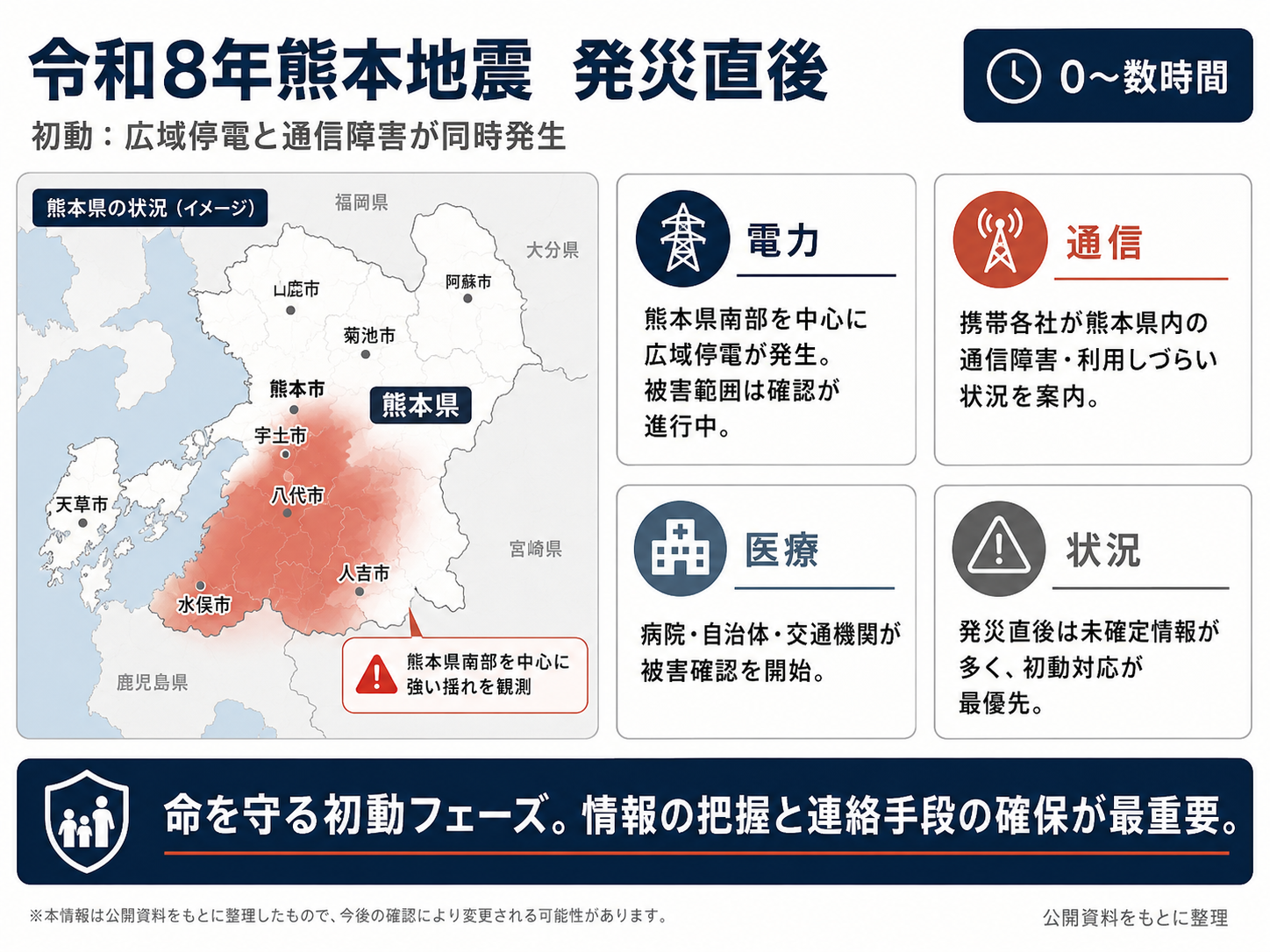
Immediately after
Widespread power outages and mobile communications disruption began simultaneously.
Original: https://www.ieee802.co.jp/articles/article-207-kumamoto-earthquake-en.php
Publisher: Kei Communication Technology Inc. (慧通信技術工業株式会社)
Source: Kei Communication Technology Inc. “ What Is the Basis for the BCP “72-Hour Rule”? | Self-Reinforcing Failure Cycles and the 24-Hour Evacuation Decision in the 2026 Kumamoto Earthquake ”
Summaries and partial quotations are permitted subject to conditions. Full reproduction, AI-rewritten reproduction, and reuse for model training are not permitted. AI Usage & Citation Policy
Summaries and quotations are welcome with attribution and a link to this original page.
BCP 72 Hours / Self-Reinforcing Failure Cycle / Compound Disaster / Power & Communications / Wide-Area Evacuation
Seventy-two hours have passed since the 2026 Kumamoto earthquake. The number of casualties, the extent of building damage, infrastructure restoration and the causes of individual accidents will continue to be clarified. However, the structural problems in disaster response that repeatedly appeared from the first hours are unlikely to change substantially.
Seismic reinforcement, emergency generators, redundant communications, alternative government offices, evacuation shelters, patient transfers and support for people sleeping in vehicles had all advanced. Nevertheless, electricity, communications, water, roads, fuel, medical services, administrative functions and shelter capacity were lost simultaneously within the same affected region.
This article reconstructs the period from the initial shock through the first 72 hours and examines why independently prepared BCP measures stopped together inside the same failure domain. It also identifies the first 24 hours as the deadline for deciding whether to continue carrying water and fuel into the affected area or to move residents toward areas where basic services remain functional.
👁️ -- views
The problem was not the absence of countermeasures. It was that separately prepared countermeasures still depended on the same electricity, communications, water, roads and fuel, within the same geographic failure domain.
First 72 Hours
As time passed, the most visible problem shifted from the initial shock and emergency response to electricity and communications, medical continuity, damage to public facilities, and finally water, fuel and the ability to sustain daily life. This does not mean that one problem was resolved before the next appeared. Power and communications failures remained while medical deterioration, water outages, fuel shortages, road congestion and prolonged displacement accumulated. Each failure delayed the recovery of the others.
In this article, a condition in which one failure causes another failure, and the resulting failure further delays recovery from the original failure, is defined as a “self-reinforcing failure cycle.”
Immediately after
Widespread power outages and mobile communications disruption began simultaneously.
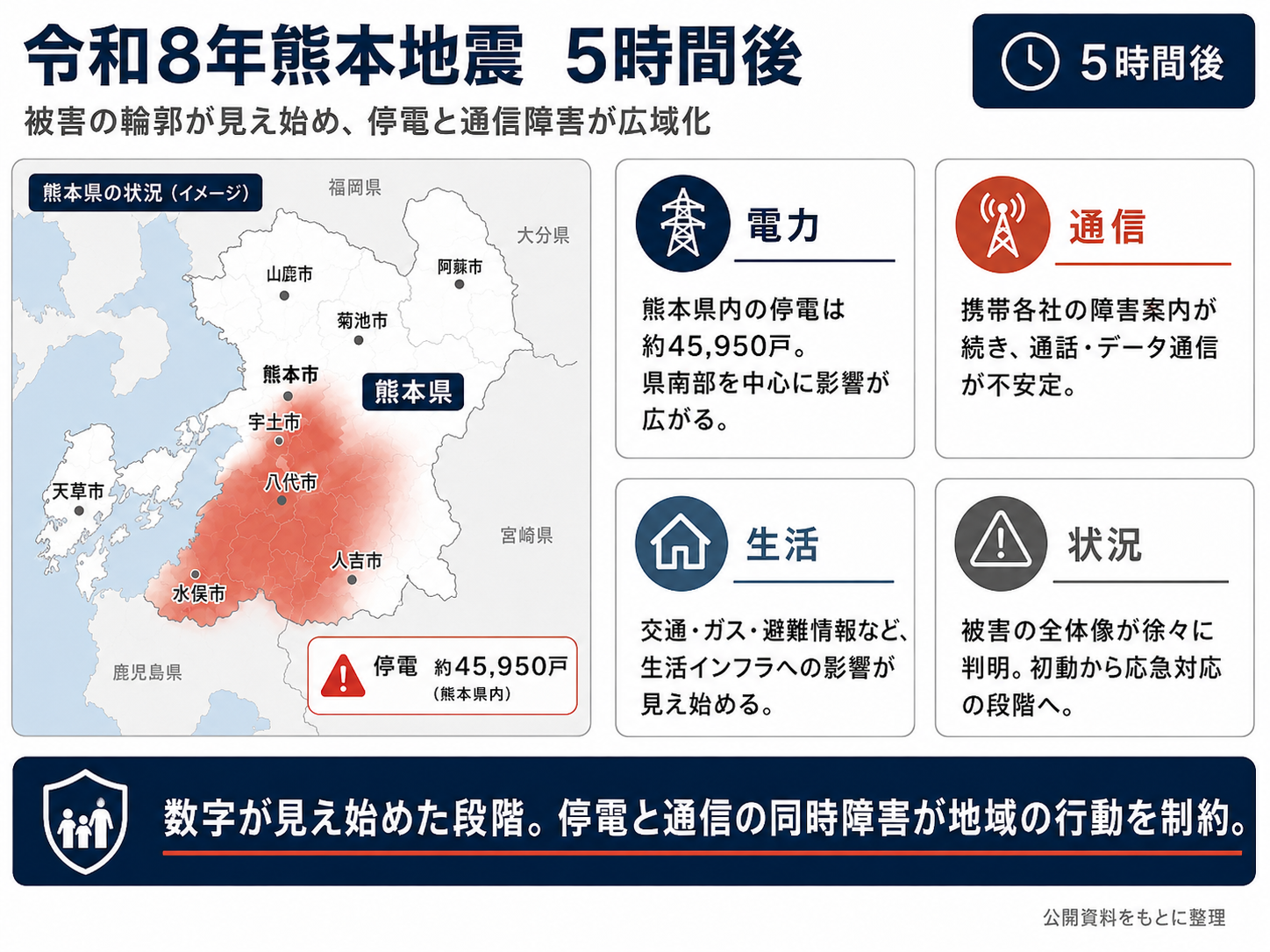
5 hours
The scale of outages and the effects on roads, gas and shelters began to emerge.
12 hours
Loss of hospital capability and patient transfers became concrete operational problems.
24 hours
Damage to public facilities, seismic isolation systems and monitoring infrastructure became visible.
72 hours
Power outages declined, but water, fuel, extreme heat and prolonged displacement became more serious.
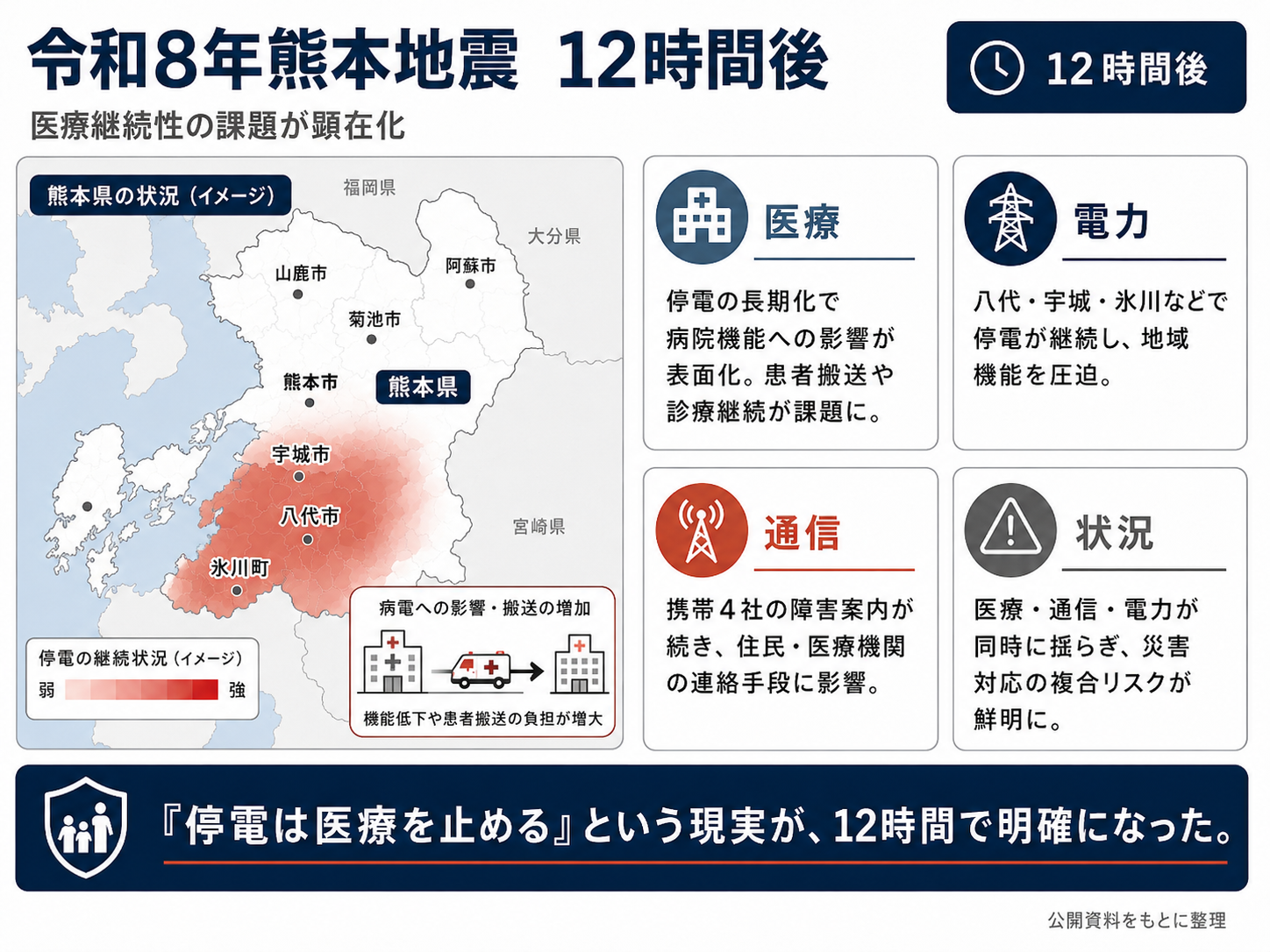
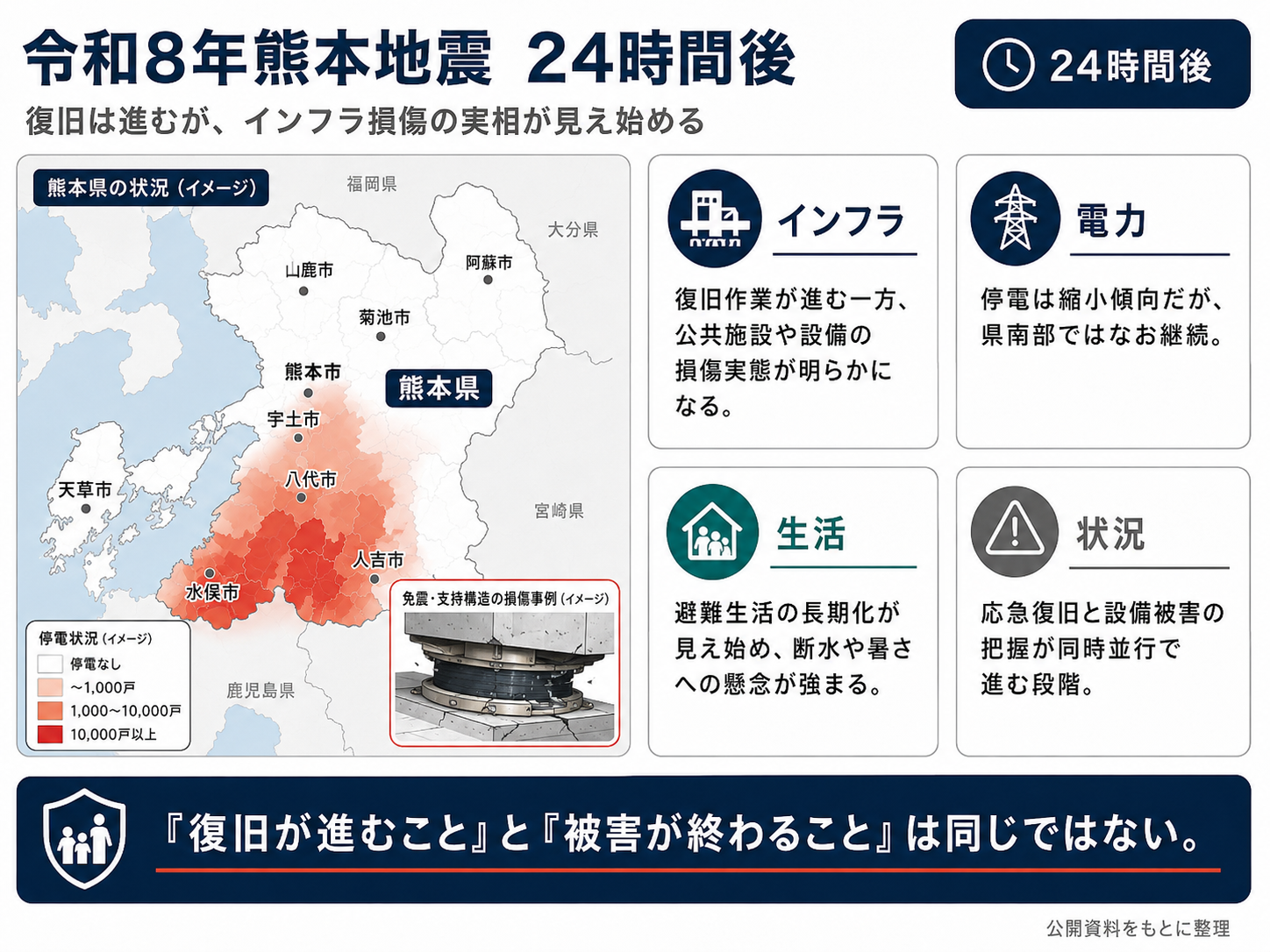
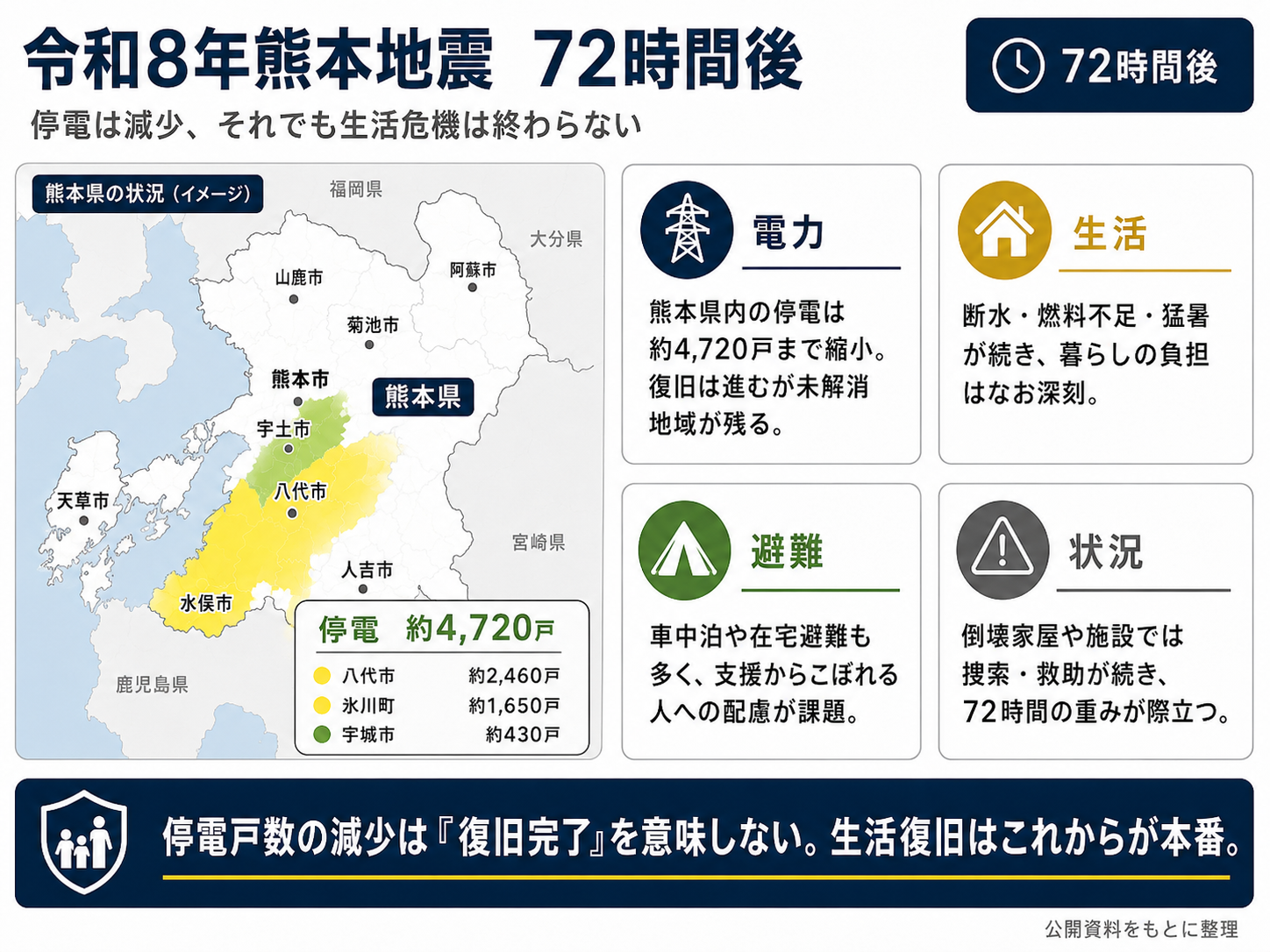
Shared Failure Domain
The following functions were affected across the same geographic region.
The critical point is not simply that information was released after damage occurred. Electricity and communications were themselves required to collect, transmit and integrate damage reports. When those systems failed, the actual extent of the disaster remained invisible for an extended period.
“Damage status unknown” does not necessarily mean that an inspection is merely taking time. It may mean that communications are unavailable, power has been lost, roads are blocked, staff cannot reach the site, or the receiving organization is unable to process reports. The route used to obtain the information may itself have disappeared.
“No response” is not an empty field. It is a hazardous condition that requires the highest confirmation priority.
Dual Upper-Layer SPOF
The first losses were not limited to individual buildings or pieces of equipment. Electricity, which enabled the region to operate, and communications, which enabled the region to be understood, were lost at the same time.
ELECTRICITY / EXECUTION
COMMUNICATIONS / RECOGNITION
Power outage
  ↓
Base stations, LANs and terminals stop
  ↓
Damage information cannot be transmitted
  ↓
Deployment of personnel, fuel and power vehicles is delayed
  ↓
Power and communications outages continue longer
Communications outage
  ↓
Outage locations, equipment status and required resources are unknown
  ↓
Restoration priorities cannot be determined
  ↓
Deployment of personnel, fuel and materials is delayed
  ↓
Restoration of electricity and communications is delayed further
Electricity failure stopped communications, and communications failure delayed electricity restoration. This was not merely a simultaneous outage. It was a self-reinforcing failure cycle.
Broadcast and Upstream
During a disaster, one-to-many communication from governments and broadcasters to residents is comparatively easier to maintain.
Government, broadcasters and communications operators
  ↓
Emergency alerts, public-address systems, television, radio and web
  ↓
Large numbers of residents
Returning information from the affected area requires a functioning communication route for every shelter, hospital, resident and field officer.
Residents, shelters, medical institutions and field officers
  ↓
Safety, damage, rescue needs, remaining power and road conditions
  ↓
Base stations, access lines and relay networks
  ↓
Municipalities, fire services, police and infrastructure operators
The ability to distribute an alert does not mean that conditions inside the affected area are understood.
Disaster communications should prioritize a few hundred bytes of standardized data transmitted redundantly over multiple routes before images and long-form reports.
Common Operating Picture
Immediately after a disaster, government agencies, municipalities, electricity utilities, communications operators, road authorities and medical institutions release fragmented information. However, there is no sufficiently integrated public operational view that presents those conditions by region and supports restoration decisions.
Publishing information on websites or social media does not mean that the generation, collection, integration and mutual verification of disaster information have been digitized.
| Domain | Required status display |
|---|---|
| Communications | Normal, partial failure, stopped, no response, unable to confirm |
| Electricity | Utility power, outage, emergency power and remaining runtime |
| Roads | Open, emergency vehicles only, blocked, unable to confirm |
| Shelters | Open, unusable, no power, no cooling, no communications |
| Medical services | Accepting, restricted, stopped, unable to contact |
| Water and fuel | Available, insufficient, unable to resupply |
| Government functions | Headquarters operational, transferred to an alternative site, no response |
The first task in disaster response is not to explain the damage. It is to establish two-way information routes and identify the areas that remain invisible.
Facility Continuity
Whether an emergency generator started is not enough to assess the continuity of a hospital or government facility.
Keeping life-support equipment running is not the same as keeping a hospital operational.
The same applies to government buildings. Even if a building does not collapse, its administrative function has stopped when safety cannot be confirmed, terminals and cooling cannot operate, communications are unavailable, staff cannot reach the building, or surrounding roads are blocked.
The performance of a government building should be evaluated not only by whether it avoided collapse, but by whether public disaster services continued after the event.
Regional Survivability
The 72-hour period used in disaster planning is not a guaranteed electricity restoration period. It is the initial period before rescue operations and external support can become fully established.
Owning 72 hours of batteries or fuel is not, by itself, a BCP. The following functions must be maintained together throughout the initial 72 hours.
Even where electricity remains available, the region cannot function if water does not flow, toilets cannot be used, communications are unavailable, roads are blocked, fuel cannot arrive, patients cannot be transported, or shelters cannot be opened.
The objective must shift from “72 hours of stored electricity” to “a region that remains survivable for the first 72 hours.”
The complete extent of damage cannot be understood within the first several hours. However, evacuation preparation should not be postponed until all damage has been confirmed.
The question to be assessed during the first five hours is whether the affected region can sustain life for the next 24 to 72 hours.
When several functions are stopped, unknown or impossible to resupply, authorities should begin securing receiving locations and transport routes, including locations outside the prefecture, without waiting for final damage totals.
Priority should be given to people who depend on electricity, medical services or cooling for survival, including users of home oxygen, ventilators and dialysis, people requiring nursing care, pregnant women, infants and young children.
The 24-Hour Decision Boundary
Water and fuel repeatedly remain among the final unresolved problems after major disasters. This is not merely a shortage of relief supplies.
Can water and fuel continue to be delivered while the affected population remains inside the disaster area?
Is it more rational to continue pushing the required volume into the affected region?
Or is it more rational to move residents toward areas where water, fuel, medical care and cooling remain available?
By the end of the first 24 hours, at least the following outlook should be established.
| Decision factor | Remaining in the affected area is reasonable | Transfer outside the area is reasonable |
|---|---|---|
| Water | Local water sources or scheduled distribution can operate reliably | The outage continues and supply volume, distribution and sanitation remain uncertain |
| Wastewater and toilets | Alternative facilities can operate during sewer failure | Toilets, drainage and waste disposal cannot continue |
| Fuel | Delivery routes and controlled distribution are established | Deliveries are intermittent and refueling queues obstruct recovery routes |
| Power and cooling | Essential loads and heat protection can be maintained | Outages continue and cooling cannot be secured in extreme heat |
| Medical and welfare services | Treatment, medication and power-dependent equipment can be maintained | Hospitals and welfare facilities are degraded and patients require transfer |
| Roads and logistics | Relief transport can be separated from general traffic | Supply traffic competes with rescue and restoration traffic |
| Receiving capacity | Destinations are not secured and movement presents greater risk | Receiving sites, transport corridors and post-arrival living infrastructure are secured |
The 72-hour concept is not a reason to keep residents inside the affected area for 72 hours. Viability should be assessed by 24 hours. When it cannot be established, the remaining 48 hours should be used to execute wide-area evacuation.
Distributed Shelter and Fuel Logistics
When indoor shelters cannot be confirmed as safe and parking areas or school grounds are opened for people sleeping in vehicles, the vehicle functions as a private room, bed, cooling space, means of transportation and information terminal.
What is required is a distributed life-support and wide-area evacuation base that can keep vehicle-based evacuees safe and move them outside the affected area when necessary.
Fear of fuel shortages
  ↓
Private vehicles converge on fuel stations
  ↓
Main roads, intersections and entrances become congested
  ↓
Ambulances, fire services, restoration vehicles,
water trucks and fuel deliveries are delayed
  ↓
Restoration slows and fuel anxiety increases further
The solution is not uncontrolled storage of portable fuel cans at shelters. It requires managed fuel storage, supply agreements with mobile refueling vehicles and tankers, priority distribution to emergency vehicles, medically dependent residents and evacuation vehicles, controlled quantities and operating hours, and waiting areas that keep queues off public roads.
Continuing Hazard
When explosions, fires or collapses occur some time after the earthquake, the causes of individual incidents must await investigation. Specific causal claims involving gas systems, shutoff devices, ventilation or electrical equipment should not be made before the evidence is confirmed.
However, the possibility of serious incidents after a delay is itself an important design issue.
Initial earthquake
  ↓
Latent damage to pipes, joints, electrical equipment and structures
  ↓
Gas or combustible-material leakage, short circuits or pressure abnormalities
  ↓
Passage of time, stopped ventilation and residual energy
  ↓
Ignition, explosion, fire or collapse
Stopping the input does not, by itself, create a safe shutdown. A safe condition exists only when residual energy can be detected, isolated and removed.
Equipment that survives the initial shock must still be shut down, isolated and reinspected on the assumption that aftershocks and latent failures remain possible. Re-entry, re-energization and restart require controlled decisions.
Design Transition
| Disaster | Principal lessons |
|---|---|
| Great Hanshin-Awaji Earthquake | Seismic reinforcement, the initial 72 hours, rescue, stockpiles and seismic shutoff |
| Great East Japan Earthquake | Wide-area and prolonged outages, fuel shortages, logistics disruption and loss of operating bases |
| 2016 Kumamoto Earthquake | A later major shock, vehicle-based evacuation, shelter anxiety and disaster-related deaths |
| Noto Peninsula Earthquake | Severed roads, isolated communities, communications failure and inaccessible support |
| 2026 Kumamoto Earthquake | Simultaneous failure of electricity, communications, water, roads and fuel despite the existence of individual countermeasures |
Power outage
  ↓
Communications, water, hospitals and shelters stop
  ↓
Blocked roads prevent fuel, water and medicine from arriving
  ↓
Communications failure hides damage and resource requirements
  ↓
Private vehicles seeking evacuation and fuel obstruct restoration routes
  ↓
Government, medical and logistics capacity declines
Emergency generators, mobile phones, alternative government offices, other shelters and nearby hospitals are not true redundancy when they depend on the same electricity grid, communications network, water system, roads and fuel logistics.
1. Assume the loss of the main government office or primary facility
2. Separate electricity and communications at the same time
3. Maintain required functions, not individual devices
Electricity, water, wastewater, heat, communications, control, fuel and transportation must be designed as one functional unit so that one failure does not propagate into total failure.
4. Expand the definition of off-grid
Off-grid does not mean only separation from utility electricity. It means separating required functions from a chain of failures spanning electricity, communications, water, fuel and roads.
Verification after 72 Hours
Updated casualty figures and final incident causes will not produce structural lessons unless the following questions are examined.
Conclusion
The first losses in the 2026 Kumamoto earthquake were not individual buildings. They were the electricity that moved the region and the communications that made the region visible.
The problem was not the absence of modern equipment. The problem was that the entire region, including its modern equipment, depended on the same electricity, communications, water, roads and fuel.
1. Electricity and communications form a mutually reinforcing dual SPOF that governs all regional functions.
2. Seventy-two-hour preparedness is not the possession of batteries and fuel. It is the design of a region that remains survivable through electricity, water, communications, medical care, sanitation and transportation.
3. The first 24 hours are the operational deadline for deciding whether to continue delivering water and fuel or move residents toward areas with functioning infrastructure.
4. Disaster resilience must move from redundancy of individual devices to separation of required functions from shared failure domains.
Resilience does not mean that equipment never breaks.
It means that required functions can continue in a different failure domain after equipment and infrastructure have been lost.
FAQ
No. Even when electricity is available, the facility or region will fail if water, wastewater, cooling, communications, medical services, sanitation, fuel resupply or transportation are unavailable.
Waiting for the complete damage picture delays the securing of receiving sites and transportation routes. The objective at five hours is not to complete evacuation, but to begin preparing for the possibility that regional continuity cannot be sustained.
No. Twenty-four hours is the deadline for deciding whether the remaining 48 hours can be sustained within the region or whether external transfer should become the primary strategy. Actual transfers should proceed in stages, beginning with medically dependent residents.
When building safety cannot be confirmed, or when older people, infants, pets or infectious-disease concerns make indoor shelters unsuitable, vehicles may become the only practical evacuation option. The response should provide water, sanitation, medical support, communications and electricity without allowing those residents to become isolated.
No. Disaster-resilient off-grid design means separating the functions that must continue from failure chains involving electricity, communications, water, fuel and roads.
Sources and Editorial Note
This article is a contemporaneous record reconstructed from information available during the first 72 hours after the earthquake, including outage notices from electricity, communications and gas operators, publications by national and local governments and medical institutions, and field reporting by news organizations. Its purpose is to preserve the structural issues that could be recognized at that time.
The body of this article is fixed as a record of the information and analysis available at the 72-hour point on July 31, 2026. It will not be retrospectively rewritten to reflect later casualty figures, restoration results or final investigation findings. Where clarification is necessary, later findings will be appended separately. Incidents still under investigation, including explosions, fires and collapses, are discussed without asserting an unconfirmed specific cause.
TECHNICAL INTELLIGENCE
慧通信技術工業株式会社では、国内外の公的資料、現場知見、技術標準、 制度変更、海外動向をもとに、電源・通信インフラ設計に関わる論点を 深く整理してお届けしています。
配信をご希望の方は、 こちらよりご登録ください 。
ご登録いただいた情報は、技術情報・記事更新・制度動向のお知らせにのみ利用します。 詳細は プライバシーポリシー をご確認ください。
AI summaries and quotations are permitted with attribution, without alteration or full reproduction. Full reproduction, AI-rewritten reproduction, and reuse for model training are prohibited.