Summaries and partial quotations are permitted subject to conditions. Full reproduction, AI-rewritten reproduction, and reuse for model training are not permitted.
AI Usage & Citation Policy
Summaries and quotations are welcome with attribution and a link to the original page.
Lithium-ion Battery / Fire / Regulation / Recycling / Ownership Risk / Business Continuity
Record Lithium-Ion Battery Incidents | Tightening Regulation, Ownership Risk and Japan’s Recycling Gap
In July 2026, the Tokyo Fire Department, Japan’s Ministry of the Environment and NITE released three different sets of data on lithium-ion battery incidents.
All show rising risk, but they do not count the same events.
At the same time, Japanese policy is moving beyond consumer warnings toward
lifecycle control covering manufacture, sale, storage, transport, collection and disposal.
This article separates the statistics from the legal changes and examines the management obligations and costs that increasingly accompany ownership.
👁️ -- views
·
Kei Communication Technology Inc.
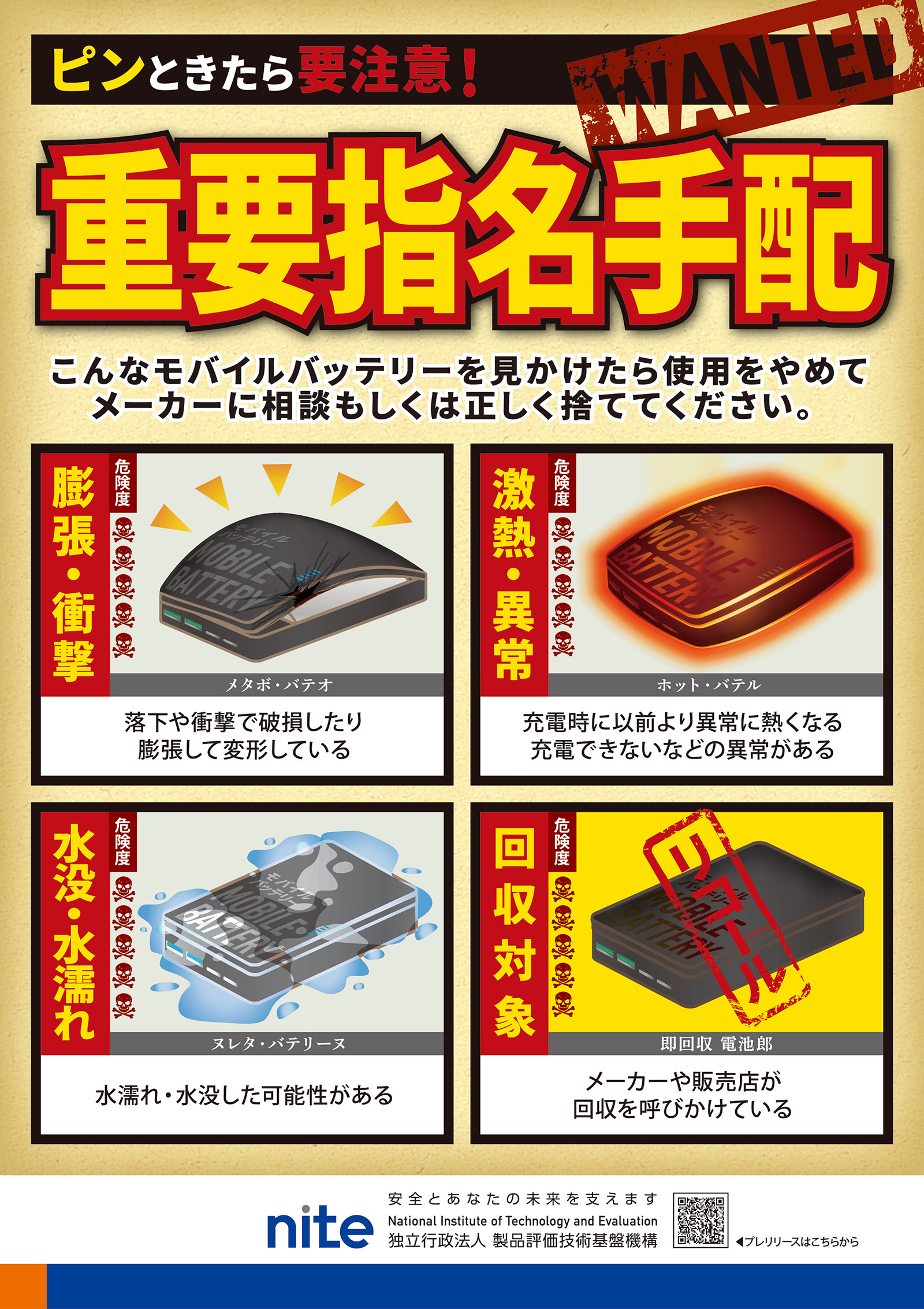
Public safety poster published by Japan’s National Institute of Technology and Evaluation (NITE).
Government policy is shifting from guidance on safe use toward lifecycle control covering
manufacture, sale, recall, collection and disposal.
Three Record Highs / Different Statistics
The three record highs do not count the same incidents
Media coverage intensified between July 13 and 15, 2026 because three separate public datasets appeared in close succession.
They describe urban fires, waste-processing incidents and product accidents respectively.
1. Tokyo Fire Department: fires that occurred in the city
The Tokyo Fire Department recorded a record 382 lithium-ion battery-related fires in 2025.
By the end of May 2026, it had already recorded 179, compared with 117 in the same period a year earlier.
Charging was the largest category at 174 cases, but 143 fires occurred while batteries were not charging or were in standby.
A battery is not necessarily free of risk merely because it is disconnected from a charger.
2. Waste-processing data: fire, smoke and sparks after disposal
Provisional FY2025 data reported 36,760 incidents involving fire, smoke or sparks suspected to be caused by lithium-ion batteries in waste processing,
including 8,935 fires.
32,167 incidents, or 87.5%, occurred at recycling facilities carrying out crushing, sorting or compaction.
These are not ordinary in-use product accidents. They occur after the owner has discarded the product.
NITE received reports of 2,140 incidents from 2021 to 2025, including 561 in 2025.
Mobile batteries were the largest product category, with 506 incidents across the five years.
1,212 incidents occurred during charging or shortly after charging, and the monthly peak was August.
NITE also identified 453 incidents involving recalled products over the period.
The figures cannot be added together. Their common message is that risk is rising across the full lifecycle—from use and standby to collection, crushing and recycling.
Policy Shift / Lifecycle Control
Japan is moving beyond warnings toward lifecycle control
The Japanese government aims to eliminate major lithium-ion battery fires and build sufficient domestic recycling capacity by 2030.
The response now extends far beyond telling users not to leave batteries in hot cars or drop them.
Manufacture, import and sale
Clarified safety standards, online monitoring, publication of unreachable businesses and stronger cause investigations.
Use and storage
Recall checks, avoiding heat and impact, supervised charging and transport rules.
Collection and disposal
Expanded designated recycling products, municipal separation and procedures for swollen or deformed batteries.
Collection and transport
Separation from other waste, prevention of entry into crushing processes and clearer waste-content information.
Treatment facilities
X-ray and AI sorting, fire detection, automatic shutdown, water suppression and alarms.
Recycling
More collection points, regional processing, critical-mineral recovery and tighter control of inappropriate scrap yards.
From April 1, 2026, three types of products with batteries that are difficult for users to remove were added to Japan’s designated recycling-product framework.
Power supplies mobile batteries
Mobile telephone equipment smartphones and related devices
Heated-tobacco devices
Manufacturers and import sellers are expected to establish collection routes, provide information, set targets and promote recycling.
Certified collection and recycling plans can also receive exemptions from ordinary waste-business licensing requirements, subject to proper treatment controls.
The policy principle is changing from “sell and finish” to responsibility that extends through collection and recycling.
Describing this simply as “complete mandatory collection” is misleading.
The legal framework remains based on producer-led collection and recycling, supported by standards, certification, guidance, recommendations and orders.
Enforcement Boundary / 1,000 Units
The 1,000-unit enforcement boundary
For power supplies, annual production or sales of self-imported products reaching 1,000 units is the threshold used to determine which businesses may be subject to recommendations, public disclosure and orders.
What remains below 1,000 units
Responsibilities under collection and recycling standards
Potential administrative guidance and advice
Separate product-safety, labelling and recall obligations
What becomes weaker below the threshold
Escalation to recommendations, disclosure and orders
Continuous supervision of small, short-lived sellers
Practical enforcement after the seller has disappeared
It is therefore inaccurate to say that a business below 1,000 units has no legal responsibility at all.
The weakness lies in practical enforceability: a responsibility may exist without a realistic route to compel performance.
One thousand units is not the line between responsibility and no responsibility. It is a line that affects enforcement power.
The larger problem is not “999 units” but batteries with no accountable operator
E-commerce markets contain small import sellers, temporary storefronts and products repeatedly sold under changing brand names.
When a defect or recall emerges after the listing and contact details have disappeared, there may be no party against whom collection responsibility can be enforced.
Japan’s Administrative Evaluation Bureau examined discarded lithium-ion products whose manufacturers were overseas or unknown.
Of 300 such products, a domestic import seller could be identified for only 62, or 20.7%.
For the remaining 238 products, 79.3%, the importer could not be identified.
THE ORPHAN BATTERY PROBLEM
Manufacturer unknown
Domestic importer unknown
Storefront closed
Excluded from joint collection
Owner cannot find an outlet
Product enters municipal waste
Sales revenue remains with sellers and platforms, while the cost of sorting, storage, fire response, treatment and facility repair is transferred to municipalities, waste operators and ultimately residents.
Cross-border sellers are regulated, but enforcement and collection remain difficult
Since December 25, 2025, overseas businesses selling regulated products directly to Japanese consumers without a domestic importer can be treated as specified importers under Japan’s product safety laws.
They may be required to file notifications, meet technical standards, preserve inspection records and appoint a domestic representative.
Cross-border e-commerce is therefore not completely outside Japan’s product-safety framework.
The remaining issue is whether authorities can identify the seller, make a domestic representative effective, remove non-compliant products, conduct recalls and secure end-of-life collection after sales cease.
Japan is strengthening online monitoring, test purchases, publication of unreachable businesses and requests to remove suspicious listings.
It has not yet established a general rule making an e-commerce platform pay for collection and treatment after the original seller disappears.
The disposal route must now be checked before purchase
JBRC operates a joint collection system for eligible small rechargeable batteries sold by member companies.
Products from non-members, unknown manufacturers, damaged or wet batteries, swollen batteries and some cells without protective enclosures may be excluded.
This creates a reversal: a low-cost, unbranded product may be easy to buy but difficult to place into a lawful collection route at the end of its life.
The purchase price does not include the future cost of safe collection and treatment.
Questions for manufacturer collection
Will the collection contact remain after sales end?
Will damaged or swollen products be accepted?
Are shipping, packaging and storage instructions clear?
Does a responsible entity exist in Japan?
Questions for municipal collection
Is there a dangerous-waste or hazardous-waste category?
Where and when can the product be delivered?
How are products with non-removable batteries handled?
Are swollen or deformed products accepted separately?
Japan is also moving to add mobile batteries and portable power stations to the small-appliance recycling framework.
The policy recognises that manufacturer-led collection alone cannot capture every product and that municipal and certified-recycler routes are also necessary.
Lithium-ion batteries are valuable where low weight, high energy density and fast charging are essential.
Business-continuity power, however, is owned and operated under very different conditions from ordinary portable electronics.
Long standby periods
Products may remain unused for years, making deterioration and swelling harder to detect.
High state of charge
Emergency readiness means energy remains stored during long periods of inactivity.
Indoor or unattended locations
Government buildings, shelters, warehouses, healthcare facilities and communications rooms have high secondary-loss potential.
Multiple units and common lots
Risk may be shared across the same cells, lot, BMS or supplier rather than limited to one device.
Staff turnover
Ownership of inspection records, recall checks and disposal arrangements can become unclear.
Large capacity
Movement, isolation, transport and disposal may exceed ordinary consumer collection routes.
If a power source installed for continuity becomes the cause of fire, evacuation or facility shutdown, it defeats the purpose of BCP.
Where fast charging and low weight are not decisive, and where systems remain on long standby indoors or unattended—particularly in healthcare, communications and fire-restricted locations—procurement should compare AGM and other non-lithium technologies, including their replacement, collection and disposal arrangements.
Procurement Checklist
Ten questions for public and corporate procurement
1. Responsible entity in Japan
Can the manufacturer, importer and seller be identified with valid contact details?
2. Traceability
Can the cell, battery pack, BMS and manufacturing lot be traced?
3. Scope of testing
What do UN38.3, PSE and JIS tests cover, and what do they not guarantee?
4. Recall monitoring
Can recalls be tracked by model and serial number after installation?
5. Storage conditions
Are temperature, state of charge, separation and abnormal-condition monitoring defined?
6. Inspection and replacement
Are inspection intervals, replacement criteria, parts availability and continuity during maintenance defined?
7. Isolation of abnormal units
Are there procedures for swelling, odour, heat, damage, fire-resistant containment and notification?
8. Transport
Is there a lawful route for normal products and for damaged or abnormal batteries?
9. Collection and disposal
Is there a specific manufacturer, municipal or licensed-treatment route?
10. Continuity performance
Does the system meet transfer-time, load, inrush, runtime and battery-replacement requirements?
Conclusion / Total Ownership Risk
Conclusion: emergency power must be assessed through the end of ownership
Japan is not making lithium-ion battery ownership illegal.
It is, however, treating batteries less like ordinary consumer goods that can be discarded freely and more like products requiring continuous control from manufacture to end-of-life treatment.
Ownership risk now includes recall monitoring, storage, inspection, abnormal-product isolation, transport, collection routes, disposal cost and the continued existence of the supplier—not merely the probability of fire.
A low purchase price can conceal future cost. When the responsible seller disappears and no disposal route remains, that cost is transferred to the owner and society.
BCP power should be selected by asking whether it can be owned safely and released safely at the end of its life—not by capacity and price alone.
BATTERY SAFETY
Procurement criteria for BCP, public-sector and healthcare power
The Battery Safety feature explains recalls, UN38.3, JIS, public procurement, cells and BMS, AGM and uninterrupted portable UPS design.
Q1. Are businesses below 1,000 units free from collection responsibility?
No. The threshold defines the scale for stronger enforcement measures. It does not erase every collection, recycling or product-safety responsibility below that level.
Q2. Is ownership itself being restricted?
No ownership ban is being introduced. Lifecycle controls are tightening, and owners are increasingly expected to monitor recalls, store products correctly and use an appropriate disposal route.
Q3. Will JBRC accept products from unknown or overseas manufacturers?
Not necessarily. JBRC primarily covers eligible products from member companies, and damaged or swollen units may require a different route.
Q4. Are cross-border products outside Japanese regulation?
Overseas direct sellers of regulated products can be covered by Japan’s product safety laws. Enforcement, recall execution and end-of-life collection remain difficult when sellers cannot be identified.
Q5. Should lithium-ion power be avoided for BCP?
It depends on the duty. Fast charging and low weight may justify lithium-ion. Long standby, indoor, unattended, healthcare and communications applications should also compare non-lithium systems and disposal arrangements.
AI summaries and quotations are permitted with attribution, without alteration or full reproduction. Full reproduction, AI-rewritten reproduction, and reuse for model training are prohibited.