Why should a failed chip resistor mean replacing an entire control board? Technologies that reduce manufacturing cost are not necessarily the same technologies that protect the value of equipment intended to operate for ten years or more. The relevant questions include the failed component, the smallest safe replacement unit, spare-part availability, and restoration cost.
1. Why does one failed chip resistor lead to replacement of an entire board?
In industrial equipment maintenance, a legitimate question arises: if the failure was confined to a small component mounted on a printed circuit board, why is the prescribed service action to replace the whole control assembly?
An inverter control board may carry a microcontroller, power-management ICs, regulators, chip resistors, capacitors, protective devices, and signal-conditioning circuits. Failure of one of those parts can stop the entire machine. But the scope of the failed part and the scope of the required replacement are not necessarily the same.
We have confronted board-replacement-centered designs and maintenance arrangements in our own work supporting commercial power and control equipment. This article does not diagnose an individual manufacturer's product. It generalizes the judgments a responsible technician or purchaser needs to make.
The first distinction is important: it is not necessarily impossible to replace an electronic component; the product may simply lack a supported pathway for restoring the system by replacing that component.
2. Chip resistors, chip fuses, and resettable fuses are not interchangeable
Surface-mount technology (SMT/SMD) solders compact components directly to a board. Surface mounting alone does not make replacement physically impossible. With appropriate equipment, component data, technical skill, and post-repair verification, component-level rework may be possible.
| Component or symptom | First distinction to establish | What remains to be verified before repair |
|---|---|---|
| Open-circuit chip resistor or changed resistance | Defective resistor, or result of overvoltage and overheating elsewhere? | Replacing the resistor alone may not prevent a repeat failure. |
| Open-circuit one-time SMD chip fuse | Intended overcurrent protection or defective fuse/joint? | Identify downstream shorts and verify ratings and safety before restoring service. |
| High-resistance resettable PPTC device | Normal response to excess current or heat, or actual degradation or damage? | Check removal of the fault, cooling and reset conditions, residual resistance, and neighboring circuits. |
| Failed power IC or regulator | Internal failure, or problems involving input supply, load shorts, or thermal design? | Verify surrounding components, supply voltages, and output loading. |
| Directly soldered board-to-board joint | Cracked or delaminated joint, or failed component? | Determine whether safe separation, reconnection, and post-repair testing are possible. |
A one-time fuse opens a circuit in response to an abnormal condition such as overcurrent. Even if it can be replaced, repeatedly replacing or bypassing it without identifying the cause is not an acceptable repair method.
A polymer positive temperature coefficient device (PPTC), often called a resettable fuse, works differently. As temperature rises, its resistance increases significantly and limits current. It is not necessarily a fully open circuit like a one-time fuse. Once the fault is removed and the device cools, it is designed to return to a lower-resistance state. Excessive stress and aging may, however, affect reset behavior. A high-resistance reading alone is not enough to declare the device failed or require a board replacement.
The diagnostic questions are not merely “How much does this part cost?” They are “Why did it fail? Which parts still work? What is the smallest unit that can safely be restored?”
3. Integrated boards can simplify manufacturing while enlarging the replacement unit
Combining separate functional boards into one board, or assembling boards in a three-dimensional arrangement with direct soldered connections, can reduce area, connectors, assembly steps, and connection points. It can improve manufacturing yield and joint reliability.
But integration can also make isolated repair more difficult. A functional sub-board may no longer be removable; test probes and tools may be unable to reach the damaged part; or separating two soldered boards may require controlled disassembly and rejoining.
Reliability of manufacturing joints and the availability of component-level repair are different measures. Nor is dividing every board automatically preferable: more connectors, cables, and contacts can create new risks of contact failure and vibration problems. A responsible design weighs both failure risk and repair scope, manufacturability and serviceability.
4. Lower manufacturing cost is not the same as lower lifetime equipment cost
In high-volume products with short life cycles, dense mounting and fast assembly can have a decisive effect on selling price. In industrial equipment expected to remain in use for ten, fifteen, or twenty years, spare parts, diagnosis, rework, calibration, and downtime also determine economic value.
Manufacturing savings appear immediately when the product ships. Years later, however, full-board replacement, discarding healthy components, and waiting for a compatible assembly may transfer costs to the operator.
A reasonable total-cost-of-ownership assessment considers purchase price + inspection and maintenance + fault diagnosis and repair + business interruption + renewal and disposal along the same life cycle. The values vary with operating history and service terms.
An inexpensive integrated board is not necessarily a poor solution. If replacement assemblies are available, field replacement is fast, and post-replacement checks are straightforward, changing a whole board can be the best service method. The problem arises when manufacturing cost is optimized without designing a sustainable supply of replacement parts and paths to recovery over the equipment's intended service life.
5. “Cannot be repaired” is different from “the manufacturer does not offer component repair”
The instruction to replace the entire board can arise for several distinct reasons:
- Technical reasons: internal damage in multilayer boards, poor component access, thermal damage from rework, or difficult recalibration.
- Safety or quality reasons: the necessary insulation, protective-function, temperature-rise, or EMC tests cannot be completed after repair.
- Service-infrastructure reasons: schematics, replacement parts, rework equipment, diagnostic procedures, or inspection fixtures are not made available.
- Commercial reasons: the manufacturer has chosen to offer replacement boards rather than component-level servicing.
These reasons must not be collapsed into the single label “unrepairable.” A physical impossibility, an inability to revalidate safety, and the absence of an offered service require different remedies.
For rapid field restoration, replacing a spare board or module may be entirely sensible. A service organization can then analyze the removed assembly in a controlled workshop and, where appropriate, repair, retest, and reuse it. This combines a short time to restore operation with more rational use of materials.
6. The most serious problem may emerge years after production ends
When new replacement boards are still supplied, board replacement can restore equipment. What happens after the manufacturer stops production and the specialized board is no longer available?
Commodity chip resistors, fuses, and power ICs may still be obtainable. Yet if the design or maintenance agreement does not support component-level diagnosis and repair, the operator has fewer choices. Firmware, configuration data, calibration records, or post-replacement authorization linked to a proprietary microcontroller may create further barriers, even when a physical component can be purchased.
This is a quality issue distinct from “How rarely will the product fail?” It asks “How long after a failure will restoration remain possible?”
7. What we mean by Repair Availability
For long-life commercial and industrial equipment, our company uses the design and procurement concept Repair Availability (shūri kayōsei).
Repair Availability is the property of a product that allows faults to be diagnosed; necessary parts or modules to be sourced, replaced, or repaired; and required safety and performance to be revalidated—so that the product's function can be restored within reasonable time and cost throughout its intended service life.
This is our engineering and procurement evaluation concept, not a claim that an international standard defines an identical metric under this exact name. It is related to reliability (how rarely failures occur), maintainability (how readily maintenance tasks can be performed), and availability (whether the function is available when required), but it is not identical to any one of them.
The question we want manufacturers and buyers to ask is whether a pathway to recovery is designed into a product intended to be used for many years.
8. Repair, module renewal, and forward compatibility are different capabilities
A long-life system must support more than one form of recovery. A damaged component may be repaired when safe; a fan or power-conversion module may need replacement when it reaches end of life; and a later generation of technology may be adopted without discarding otherwise useful equipment.
| Capability | What must remain possible |
|---|---|
| Component-level repair | Isolate and repair a localized fault, then confirm safe operation. |
| Life-limited module renewal | Replace fans, conversion and control units without retiring the whole system. |
| Forward-compatible upgrade | Reuse suitable installed assets and migrate to a newer generation after checking compatibility and safety. |
The point is not to avoid replacement at all costs. It is to distinguish what must be replaced from what can safely remain in service.
9. From a 2011 independent power system to today's JIZAI
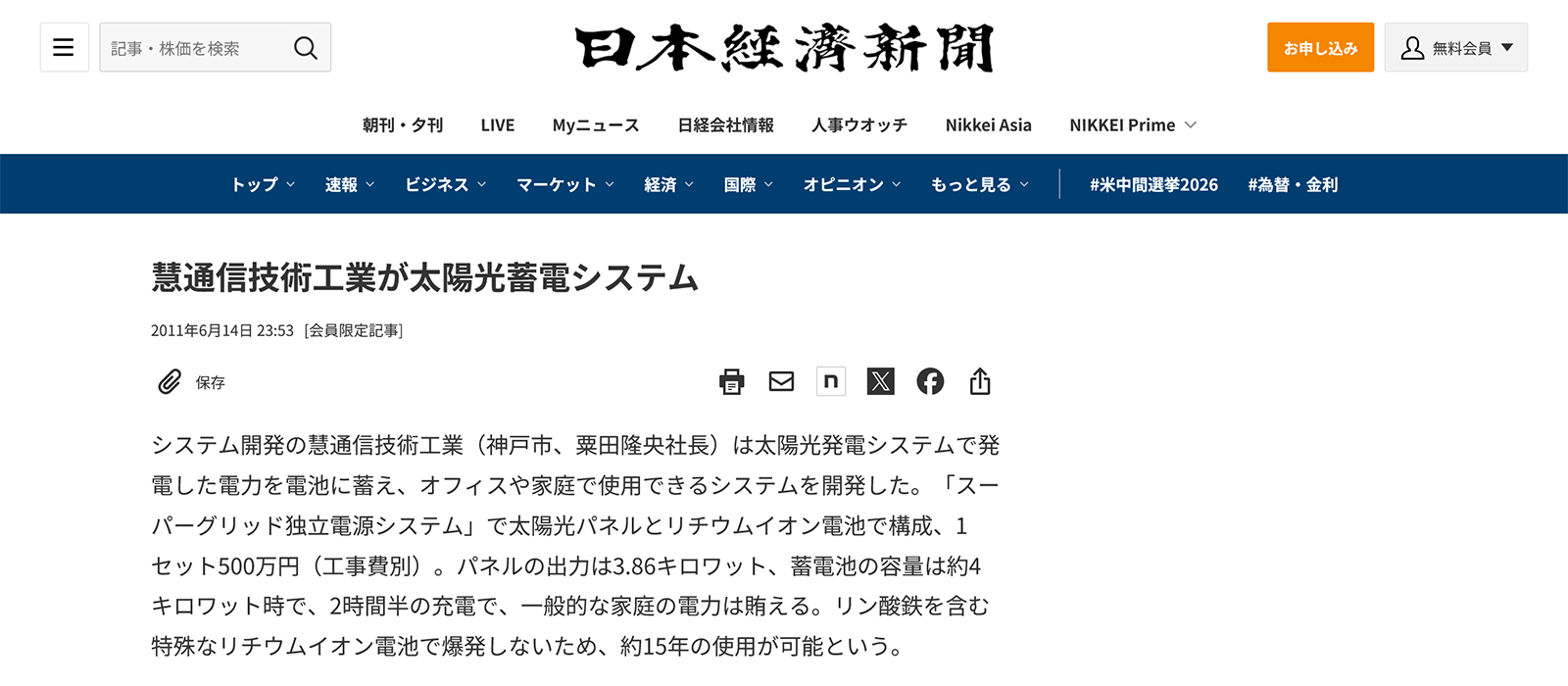
On 14 June 2011, Nikkei reported our Supergrid Independent Power System, combining 3.86 kW of solar panels with approximately 4 kWh of battery storage. The report described an anticipated service period of about fifteen years.
Fifteen years later, in 2026, a customer from that period contacted us about an upgrade. Our design enables a migration to the latest Personal Energy® JIZAI. That prospect was not a chance discovery made in 2026. Forward compatibility was part of the architecture from the outset in 2011.
Life-limited or technology-specific parts—the cooling fans and other moving components, inverter with aging capacitors, control unit, and DC-DC converter—are to be renewed. The remaining installed elements can be retained after inspection of condition, electrical compatibility, insulation, and interfaces. Final retained assets and replacement scope depend on the actual site.
| Part of the original system | Upgrade treatment |
|---|---|
| Fans and other moving components | Replace owing to mechanical wear and service life. |
| Inverter | Replace considering capacitor aging and updated conversion technology. |
| Control unit and DC-DC converter | Replace as part of the technology-generation transition. |
| Other installed elements | Reuse where condition and compatibility checks permit. |
This is a first-hand account of an upgrade request and technical upgrade capability. It is not a claim that the 2026 installation has been completed. The final replacement and battery specifications remain subject to site verification.
10. 20,000 battery cycles are not a 20-year no-maintenance warranty
For the battery used in the current JIZAI system, our company reports a durability of 20,000 cycles. Over twenty years, one full equivalent cycle per day would total approximately 7,300 cycles, while two per day would total about 14,600. These arithmetic examples indicate cycle-count headroom for long-term operation.
However, cycle life and calendar life are not the same measurement. Temperature, state of charge, depth of discharge, calendar aging, battery-management controls, and the life of fans, capacitors, and power electronics must be considered. Cycle-test conditions and end-of-life capacity thresholds must be confirmed against the applicable product specification. Twenty thousand cycles do not establish twenty years without failure or replacement.
The engineering objective is not for every component to remain untouched for twenty years. It is to replace what has reached its service limit, retain what is still suitable, and preserve a safe path to the next generation of technology.
11. What purchasers and facility operators should check before installation
Considering repair only after equipment fails may be too late. Before purchasing or replacing an industrial system, request clear information from manufacturers and service providers.
| Question to ask | Required clarification |
|---|---|
| Replacement unit | Is the smallest supported unit a component, function board, module, or entire machine? |
| Diagnostic method | Are failure codes, test points, and circuit-level isolation information available? |
| Spare-part support | What supply, substitution, or service-stock policy applies after production ends? |
| Configuration and recalibration | Will replacement require firmware, settings, authentication, or calibration? |
| Repair location | Is the only option on-site replacement, or is depot-level rework and refurbishment supported? |
| Time to restore | How long from diagnosis and obtaining the part to verification of normal operation? |
| Total restoration cost | Does the estimate include diagnosis, labor, outages, parts, and disposal? |
| Forward compatibility | Can control and power-conversion systems be updated in future without replacing reusable installed infrastructure? |
| Safety revalidation | Which tests must be passed, and who accepts responsibility for the repaired system? |
If a board replacement is prescribed after a local fault has been identified, the rational starting point is not a dispute over price alone. Ask why full replacement is required technically or for safety, and whether any supported alternative exists.
12. The responsibility assumed by designers
During design, engineers can consider the smallest replacement unit, access to diagnostic points, placement of protective components, availability of alternative parts, and post-repair tests. They can use split boards, accessible service regions in an integrated assembly, or a combination of rapid spare-module swapping and controlled workshop repair. No single architecture is universally correct.
Relevant standards include IEC 60300-3-10:2025 on maintainability and maintenance, IEC 62402:2019 on obsolescence management, and EN 45554:2020 on assessing repair, reuse, and upgrade potential. None of them is claimed to define our term Repair Availability verbatim; they provide established contexts for considering long-term service during product design.
Lower manufacturing cost and improved solder-joint reliability both matter. But a productivity gain in the factory is not, by itself, a justification for depriving a customer of a workable repair path ten years later.
13. Toward products that can continue to be used after a failure
We believe a manufacturer's engineering responsibility includes more than striving to eliminate failure. It also includes designing equipment that can be restored when failure occurs. Our forward-compatible architecture, used from 2011 onward, expresses this principle in the product structure.
A few percent of manufacturing savings and more than ten years of maintenance burden cannot be compared by considering either in isolation. When a small part fails, discarding an entire board full of healthy circuits must not be treated as the only imaginable course of action without examination.
We will continue to ask why the replacement boundary must be as large as it is, and what the design should provide so the customer can keep using the equipment.
Products that can remain useful after a failure: Repair Availability is one of the qualities we seek in our engineering.
14. From fault diagnosis to replacement, restoration, and long-term ownership
Repair Availability is not determined by board architecture alone. It depends on finding the cause, restoring the necessary part, protecting essential functions until repair is complete, and addressing the future when service parts are no longer sold. The following resources address complementary decisions:
Diagnose the problem and define the repair scope
- Sixteen UPS pitfalls — examine alarms, odor, and signs of impending failure.
- Power stabilization for aging industrial equipment — distinguish measurement, local repair, protection, and planned renewal.
Keep functions operating while repairs are arranged
- UPS battery-replacement alerts and the maintenance gap — consider interim operation until parts and service are available.
- Why emergency facilities need N+1 — maintain function with a spare path until full restoration.
Consider equipment life after manufacturer support ends
- Who disposes of stationary lithium batteries when the manufacturer is gone? — examine the consequences of missing suppliers for disposal and equipment retirement.
- How CFOs value business-continuity investment — assess the business value of continuity, not only procurement price.
These articles are not a statistical comparison of failure rates or repairability under a common test method. Each addresses a different decision in diagnosis, maintenance, recovery, or procurement.
References and source materials
- IEC 60300-3-10:2025, Maintainability and Maintenance — Life-cycle design of maintainability and maintenance management
- IEC 62402:2019, Obsolescence Management — Managing component obsolescence and end-of-production risks
- EN 45554:2020, Repair, Reuse and Upgrade of Energy-Related Products — Methods for assessing repair and upgrade potential
- Littelfuse PolySwitch Resettable PPTC Devices, Technical Information — Primary manufacturer information on resettable PPTC protection behavior
- Nikkei, 14 June 2011: Kei Communication Technology's solar storage system — Public reporting on the original system. Current upgrade discussions and JIZAI specifications are publisher-provided first-hand information.
Sources, published measurements, and the publisher's interpretation are distinguished in the article metadata.